2026 Symposium Presenter: Cutcha Risling Baldy

2026 Online Symposium: May 3, 2026

“We Are Dancing For You: Native Feminisms and the Revitalization of Women’s Coming-of-Age Ceremonies in California”

Panel: “Revitalizing Sacred Ceremony”

Dr. Cutcha Risling Baldy

Dr. Cutcha Risling Baldy is an Associate Professor of Native American Studies at Cal Poly Humboldt who researches Indigenous feminisms, California Indians, Environmental Justice, Traditional Ecological Knowledge and decolonization. She is the Co-Director of the NAS Rou Dalagurr Food Sovereignty Lab & Traditional Ecological Knowledges Institute where she leads several research projects focused on the resurgence of Indigenous Science and place-based learning. In 2025 Dr. Risling Baldy along with Co-Director Dr. Kaitlin Reed were awarded the James Irvine Foundation Leadership Award for their work with the lab.
Dr. Risling Baldy is the Principal Investigator for the “Food for Indigenous Futures Project” which looks at connections between food justice, food sovereignty, mental health, and substance abuse prevention for Native American Youth. ​She has also helped organize several community facing events like the Northern California #LandBack Symposium, the Water Advocacy & Water Protectors Certificate Program, the Humboldt Indigenous Foods Festival, and the California Indian Conference. Dr. Risling Baldy is also the Program Coordinator for the Masters of Social Science in Environment & Community.

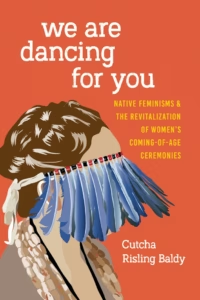
Her book: We Are Dancing For You: Native Feminisms and the Revitalization of Women’s Coming-of-Age Ceremonies received “Best First Book in Native American and Indigenous Studies” at the 2019 Native American Indigenous Studies Association Conference. The book uses a framework of Native Feminisms to locate revitalization within a broad context of decolonizing praxis and considers how this renaissance of women’s coming-of-age ceremonies confounds ethnographic depictions of Native women; challenges anthropological theories about menstruation, gender, and coming-of-age; and addresses gender inequality and gender violence within Native communities. The book is available with the University of Washington Press. She received her Ph.D. in Native American Studies at UC Davis; her M.F.A. in Creative Writing from San Diego State University; and her B.A. in Psychology with a Specialization in Health and Development from Stanford University. ​

In 2007, Dr. Risling Baldy co-founded the Native Women’s Collective, a nonprofit organization that supports the continued revitalization of Native American arts and culture. She is Hupa, Karuk, and Yurok and enrolled in the Hoopa Valley Tribe.

Hupa Flower Dancers, photo by Cutcha Risling Baldy

Abstract: This presentation focuses on the revitalization of the Hupa Flower Dance ceremony and documents how women in the Hoopa Valley Tribe worked collectively to restore a traditional women’s coming-of-age ceremony that had been disrupted by colonization. Drawing from oral histories, archival materials, community collaboration, and personal experience the book explores how cultural revitalization operates as both an intellectual intervention and a lived political act.  “Native feminisms” are frameworks grounded in Indigenous epistemologies rather than Western feminist paradigms that also challenge colonial narratives that have framed Indigenous ceremonies, in particular those related to menstruation and girlhood. Instead, this shows how the Flower Dance affirms gender balance, community responsibility, and the sacredness of young women’s transitions into adulthood. By centering Indigenous women’s voices this reframes coming-of-age ceremonies as sites of empowerment, survivance, and sovereignty. Reclaiming ceremony is not merely symbolic; it actively restructures community relationships, restores cultural knowledge, and resists ongoing settler colonialism. Blending memoir, ethnography, and theory, We Are Dancing for You ultimately positions Indigenous women’s ceremonial practices as vital to decolonial futures.

See Cutcha’s work in the video Honoring Women: Reclaiming Coming of Age Ceremony


2026 Symposium Presenter: Arieahn Matamonasa Bennett

“Western Science is ‘half-brained.’ Indigenous Elders had it right: Rethinking Animal-Human relationships and research

Panel: “Dethroning Human Hubris”

2026 Online Symposium, May 3 2026

Reimagining Goddess Scholarship:  At the Edges of Sacred Knowledge


Arieahn Matamonasa Bennett

Arieahn Matamonasa Bennett, PhD, joined ASWM after completing her Ph.D. in 2005, mentored by the late Patricia Monaghan, and has been a frequent contributor and speaker and a member of the ASWM Advisory Board. She completed her MA and Ph.D. in clinical psychology from Fielding Graduate University and is a licensed psychologist. She is an Associate Professor with the School of Continuing and Professional Studies (SCPS), at DePaul University where she has taught for the past two decades. She has widely published and taught in multidisciplinary research areas: Cross-cultural, ethnic minority & indigenous psychology, women’s psychology and the history, science and psychology of human-animal relationships. In addition to teaching, she maintains a small private practice which incorporates Equine Assisted Psychotherapy and experiential learning in nature as a part of holistic therapeutic practice.

Presentation Description:  We have deep and powerful experiences with horses and nature that are difficult to describe and quantify with our rational, scientific minds. Understanding and integration happens in the metaphoric mind of dreams, symbols, storytelling, myth, dance, art, and music. Based on theories ranging from Jungian (Depth) psychology to the pioneering work of Samples (1976, 1993) and (ancient) indigenous scientific paradigms (Cajate, 2000; Couture, 2013; Wilson, 2008), animal-human studies are given what is often a missing or invisible lens. The metaphoric mind, or ‘nature mind’ is our oldest mind and has been developing for about three million years. Western society and its educational systems focus on mainly left-brain functions such as linear thinking and language. Metaphoric, symbolic perception and intuitive, right-brain activity has been neglected. As language and the rational mind develops, the holistic experience of the metaphoric mind eventually recedes into the subconscious, but it can, however, still be called on or accessed during creative or spiritual experiences. Metaphoric mind processes are tied to creativity, perception, images, physical senses, and intuition. “This presentation explores the ways in which accessing and giving equal regard to the metaphoric mind holds important keys to a more whole-brained scientific paradigm, shaping, deepening, and advancing our understanding the animal-human bond and our connections to the natural world.

Leah Dorion’s Artwork Graces our 2026 Symposium

Passing Water Forward, by Leah Dorion (acrylic, 2013)

Our thanks to Leah Marie Dorion for sharing her artwork with us for our 2026 Symposium, “Reimagining Goddess Scholarship:  At the Edges of Sacred Knowledge.”

The program for this event reframes knowledge transmission and curation and promotes new connections and relationships among people, animals, and the green world.  Leah’s painting, “Passing Water Forward”  beautifully conveys the intention and spirit of our program, as sacred knowledge is passed from one generation to another..

Leah Marie Dorion is a Metis writer and artist currently living near Prince Albert, Saskatchewan, Canada. Her artwork celebrates the strength and resilience of Indigenous women and families, and echoes the beauty found in traditional beadwork. Leah is also a published children’s book author and illustrator.  Leah has a passion for early year’s education and is currently working with the Metis Nation of British Columbia (MNBC) to develop Metis cultural early years resources for children and families.  She has also participated as a mentor and lead artist for the Mann Art Gallery Indigenous Residency Project.  She is a proud member of CARFAC which is the national voice of Canada’s professional visual artists.  Visit www.leahdorion.ca for more information about her artistic practice.

About this painting, Leah says “This artwork features Indigenous women gathering water from the river. The gathered water is carried within sacred vessels to represent the passing forward of knowledge about the land and water through the generations. There is a baby in a cradleboard on the mother’s back and a young girl helping to draw up the river water into her vessel to emphasize that water is necessary for life to blossom, grow, and flourish in this world.

“Holding a vessel of water in our arms, close to our heart, is representative of sharing your wisdom and knowledge to guide future generations. The Canadian Geese flying in the sky are a symbol about how important it is to find direction in life and work together as a community for the highest good of all.”

In this beautiful video, Leah discusses her artistic vision.


2025 Conference Panel: Sacred Places, Living Lands and Memory

Saturday, March 29, 2025, Westward Look Inn, Tucson AZ

The Externsteine, in the Teutoburg Forest

Sacred Places, Living Lands and Memory

with Dilsa Deniz, Sarah Chandler, Constance Tippett and Dawn Work-Makinne

  • Shamir (Diamond Toothed) Worm – Pacifist Slave or Anti-Prophetic Savior: Exploring Ancient and Modern Jewish Myths of Soil and Stone, Sarah Chandler
  • Herda Dewresh – The Sacred Earth in Kurdish Alevi Tradition, Dilsa Deniz
  • Moons at Serpent Mound, Constance Tippett
  • Animism, Indigeneity and Memory, Dawn Work-Makinne

Dilşa Deniz, a Kurdish anthropologist with a Ph.D. in Social Anthropology and an MA in Women’s Studies. Her research focuses on gender, culture, mythology, eco-spirituality, and environmental challenges in Kurdish Alevi communities, addressing racism and internal colonization. In her book Shamaran: The Neolithic Eternal Mother, is one of the oldest Mother Earth Goddesses she introduces.

Kohenet Shamirah Bechirah aka Sarah Chandler is a Brooklyn-based Jewish educator, artist, activist, healer, and poet. She teaches, writes, and consults on issues related to Kabbalistic dreamwork, earth-based spiritual practices, mindfulness, and farming. She has been teaching Jewish eco-ritual weaving for over 20 years. An advanced student of Kabbalistic dream work at The School of Images, she also holds a M.A. in Jewish Education and a M.A. in Hebrew Bible from the Jewish Theological Seminary, and a certificate in Non-Profit Management and Jewish Communal Leadership from Columbia University. As the CEO of Shamir Collective, she coaches high-profile and emergent artists, musicians, and authors to weave portals for the next stage of creativity. She has served on the ASWM board since 2020, both as outreach manager and acting treasurer, as well as a core volunteer since 2019.

Constance Tippett is best known for her “Goddesstimeline that shows 40,00- years of imagery of women and Goddess throughout history. She also makes museum quality clay replications of Goddess statues. She is now working on a project to try and decode the meaning of Serpent Mound, which is an astronomical monument made by the indigenous People of the Americans.

Dawn Work-MaKinne, Ph.D., is an independent scholar interested in animism, the sacred feminine and Germanic Europe. Her work has appeared in Goddesses in World Culture and in ASWM conference proceedings, and she completed the final content-editing of Patricia Monaghan’s last Book of Goddesses and Heroines. She lives, studies and teaches in a forest grove in Des Moines, Iowa.

Read all about the ASWM Conference and register  here.


2025 Brigit Award for Excellence in the Arts: Lauren Raine

Awarded on Saturday, March 29, 2025, Westward Look Inn, Tucson Arizona


Hecate by Lauren Raine

2025 Brigit Award for Excellence in the Arts Awarded to Lauren Raine

This award given in recognition of her decades of creative endeavor as a temple mask-maker, creatrix of art installations, sculptress, ritual theatre performer, painter, author, visionary, and mythographer.

The award letter for Lauren reads in part:

The Masks of the Goddess Project, perhaps your best-known work, consists of stunning masks crafted in the tradition of Balinese temple-masks. These masks were created to reclaim the stories of  female deities from across the world’s cultures, and to empower women to explore each archetype within themselves  With the Masks of the Goddess you collaborated with dancers, ritualists, playwrights, storytellers, priestesses, and activists to bring the Goddesses into the world through the words of the women who wore their masks and wrote their stories. Since their creation in 1998, the Masks of the Goddess have traveled throughout the US and abroad, touching and transforming the lives of hundreds of women.  

Lauren Raine Portrait
Lauren Raine

We honor you also for the shrines and icons you have created. Your ongoing series entitled: Earth Shrine, is a product of your lifelong conversation with the numinous intelligence in nature.

 Out of that conversation you have also created NUMINA: Masks for the Elemental Powers which is your elucidation of the magical sense of communion with place. As you said, “In the past “Nature” was not a “backdrop” or a “resource” – the World was a conversation.” 

In Our Lady of the Shards, you celebrate the forgotten women of history: midwives, wise women, weavers, spinners, Goddesses and priestesses. In Shrine for the Lost: the Sixth Extinction (2022), you created a book, and art installation for the 2023 World Parliament of Religions, emphasizing the magnitude of the loss our biosphere has suffered.

With your four sculptures The Guardians, which symbolize and invoke the Guardians of the Four Directions, as well as the Four Elements, you cast a circle of protection to safeguard us from further ecological loss. In Spider Woman’s Hands you weave, reveal, and remember a vision of a unitive, co-creative world through sculpture, weaving, and performance.

Ancestral Midwives by Lauren Raine

Writing about mythology you have observed: “We’re dancing the future into the world by the stories we tell: like the web of the Native American creatrix Spider Woman, the threads of myth are spun far behind us, and weave their way far into the futures of those not yet born.

“May we dance empathy instead of despair, may we tell the stories that make life sacred and loving, profound and reverent.”