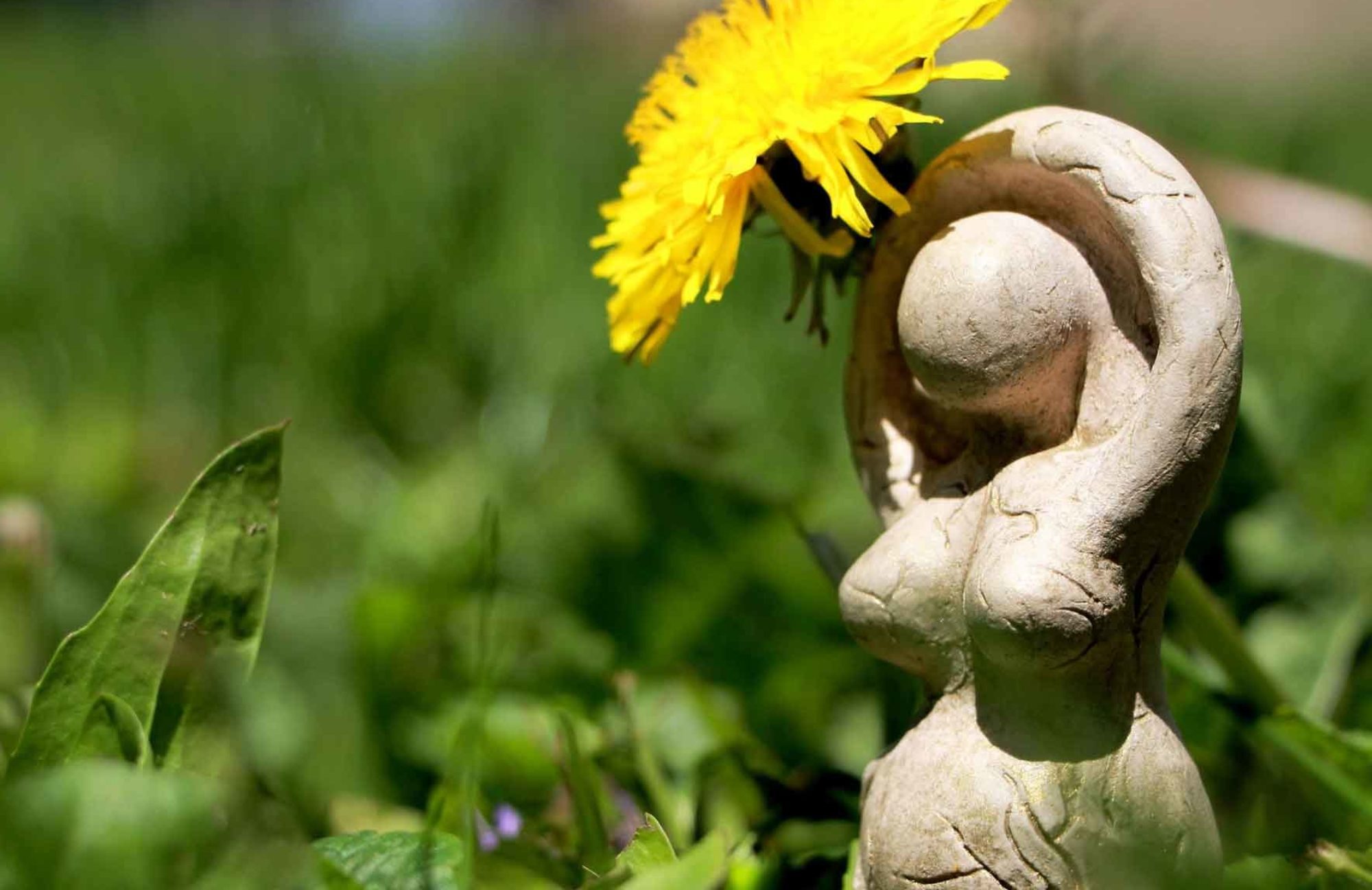
Tlazolteotl: The Goddess of Filth

Author: Anne Key, PhD
Beltane 2009, Vol 8-3
From the Archives of MatriFocus
A Cross-Quarterly Web Magazine for Goddess Women Near & Far
Discover More: “ASWM Presents MatriFocus


Tlazolteotl
Photo © 2007 Anne Key.

My heart is a flower, the corolla opens;
Ah! It is the mistress of midnight and She has arrived
Our Mother, the Goddess Tlazolteotl.
(Hymn to Tlazolteotl, from Baéz-Jorge 101)[1]

She is easily identified, usually with black around her mouth, sometimes with a conical hat or riding a broom, and often squatting in a birth-giving posture. Tlazolteotl is one of the most endearing and complex goddesses of the Mesoamericans.

Her name is derived from the Nahuatl word for garbage, tlazolli, literally “old, dirty, deteriorated, worn-out thing … which was used to connote filfth, garbage, or refuse, all of which subsumed human waste products” (Klein 21). Tlazolli could also refer to profligate behavior, related to the root for quail (zolli), a bird associated with fertility and the earth “owing to its tendency to keep close to the ground and to its prolific breeding habits” (Sullivan 11). Indeed Tlazolteotl both provoked and pardoned licentiousness, explaining Her moniker “The Eater of Filth.”

The second part of Her name, teotl, signifies a deity, and in this generic form could refer to male or female. However, Tlazolteotl is almost always considered female. The early Spanish clerics compared Her to the Roman Venus because of Her connections to sexuality. Tlazoltetol not only encompasses illicit love, overindulgence, and dissolute behavior but also is the pardoner for those who engage in Her excesses.

Tlazolteotl is considered a lunar and agrarian Goddess. She is identified with the trecena [2] of the ritual calendar that begins with the day Ce Ollin, or First Movement. She is associated with the day sign of the jaguar. She was honored by the peoples of eastern coastal Mexico, the Huastecs, Mixtecs, and Olmecs, as well as the Aztecs of central Mexico. She was known by various names, including Tlazolteotl-Ixcuina and Tlazolteotl-Tlaelquani, indicative of Her many aspects.


Detail, page 39 of the Codex Borgia, courtesy of Wikimedia Commons.

Fertile and Generative Black
Tlazolteotl-Ixcuina originated in the rich fertile areas of the Huastec peoples in the lands bordering the Gulf of Mexico in the modern states of Hidalgo, Veracruz, San Luis Potosí and Tamaulipas. The Huastec region is a rich fertile area, especially known as a cotton growing region, with a long history of trading with Central Mexico. In a statue from post-Classic Huastec, Tlazolteotl-Ixcuina wears a conical hat indigenous to this region. On page 39 of the Codex Borgia [3], a ring of Cihuateteo (women who died in childbirth and were deified) dance around two figures. The Cihuateteo wear the typical red and black skirts and huipils of Tlazolteotl, adorned with crescent moons. The shells on their skirts, as well as the typical Huastec crescent moon nose ornament, connect them with the lunar cycles. Though the moon was considered the purview of a male deity, the cycles, the regenerative aspect, and the motion were female.

A number of Tlazolteotl figurines were part of an offering burial in honor of the Cihuateteo. These figurines show Tlazolteotl in Her aspect as midwife. In each hand She holds the bands used in traditional postpartum binding practice.[4] Though more obvious on these figurines in person than in photo, Her mouth is painted black.

In fact, Tlazolteotl’s most distinctive feature is the black on Her mouth and chin. The Olmecs used bitumen, a black viscous material, as paint for decoration on everything from pottery to the human body. Bitumen was chewed publicly only by girls and unmarried women (McCafferty 33)[5].

Bitumen (also called tar or asphalt) is the byproduct of decomposed organic materials. Could there possibly be a more apt decoration for Tlazolteotl than a paint made of deep, black, decomposed material associated with the burgeoning sexuality of young women? The black around Her mouth is linked with Her role as an “eater of sins,” as the “eater of filth,” but here the sin and filth are transformed into symbols of the dark erotic genesis of life.

Spinning, Weaving, and Sex
In her name Tlazolteotl-Ixcuina, the Ixcuina is from the Huastec for “Goddess of Cotton” (Sullivan 12). Her headdress usually includes two spindles of unspun cotton, which connect Her to weaving and to the rich cotton-growing region of the Huastec.


Tlazolteotl riding a broom.
Drawing © 2009 Sage Starwalker Collins, after the Codex Fejérváry-Mayer (circa 1400-1521), World Museum Liverpool (England).

In Mesoamerica, woven cotton textiles were used as a medium of exchange, and women were the principle weavers, bringing money and prestige to the household through their weaving. A spindle full of thread is also called a mazorca, the word for a full ear of corn, as they are similar in form. The strands of cotton that hang from the spindles in Her headdress mimic the tassel on the ear of corn. The life-cycle of corn parallels the cycle of spinning, from waxing to waning, and both parallel the human life cycle (Sullivan 28-29). Cotton had other connections to the female cycle, as the bark of the cotton plant was used for uterine contractions and to induce menstruation (Sullivan 19).

The act of weaving also had sexual connotations, as we see in this Nahuatl riddle: “What is it that they make pregnant, that they make big with child in the dancing place? The answer is ‘The spindles,’ and the dancing place is the bowl where the spindles are set” (Sullivan 14). Spinning and weaving were tied to women’s lives in metaphoric and concrete ways.[6]

Tlazoteotl-Ixcuina is associated with a four-part sisterhood: First Born, Younger Sister, Middle Sister, and Youngest Sister, each of which is named Tlazolteotl. This quadripartite representation may have lunar aspects, as the four phases of the moon (Baéz-Jorge 100). These sisters were the goddesses of carnality or lust, and the cleric Sahagún writes that “their names signified that all women have an aptitude for carnal acts” (36). I interpret this as an illustration of the female capacity, throughout her life, to embody the sacred cycle of generation, death, and regeneration. And certainly lust, the drive for connection and regeneration, is seated deeply in the female purview, and here most obviously connected to lunar cycles.

Purification and Pardoning
As Tlazolteotl-Tlaelquani, she is the “Eater of Excrement”, the pardoner of sins. Sahagún writes that the old or terminally ill would seek Her because this absolution could only be given once in a lifetime. Her clergy would not only hear confessions and grant absolution but would also find those, especially adulterers, who did not confess and bring them to public punishment. Tlazolteotl was invoked at a new birth, to cleanse a baby of her parents’ transgressions.

From the Tonalamatl de los Pochtecas comes a lovely image of Tlazolteotl. She is nude, wearing an elaborate headdress, and riding a broom. Her headdress includes the usual spools of unspun cotton, as well as a shell, showing her ties with the lunar cycles. She is drawn with a wrinkled paunch, symbolic of a woman who has given birth. She holds a red snake, symbol of the fertility of menstrual flow (Baéz-Jorge 100) The broom is a reference to the Aztec purification festival of Ochpaniztli, which honored the female deities, including Tlazolteotl.

As Tlazolteotl-Tlaelquani, She was the Goddess of the black, fertile earth, the rotting earth, the fecund earth that gains its energy from death, and in turn feeds life. Associated with purification, expiation, and regeneration, She turns all garbage, physical and meta-physical, into rich life.


Detail, page 13 of the Codex Borbonicus, courtesy of Wikimedia Commons.

Embodying the cycle
Tlazolteotl, Goddess of Cotton, Goddess of Filth, Eater of Excrement. She is the regenerative power of the earth, the midwife, and the pardoner. One of the most provocative renditions of Tlazolteotl is from the Codex Borbonicus. She squats in the birth-giving position, wearing the conical Huastec hat with tassels, similar to the tassels on new corn. She wears black and red, decorated with crescent moons which, to my eye, mimic the shape of a vulva.

This drawing shows Tlazolteotl conceiving a child (see the child coming from above and to the right, footprints leading to the place of conception, the head), and She births a child who wears a headdress, earrings, and necklace just like her mother. While embodying this cycle of life, Tlazolteotl wears the flayed skin of the sacrificial victim (the dimpled skin always signifies this, but it is very obvious here with the extra hands hanging below), a symbol of death feeding life.

Tlazoteotl is associated with the trecena beginning with Ce Ollin, 1 Movement. The glyph for ollinshows the combining of two elements to form movement, symbolizing the active principle. The symbol for ollin is here as well in the two snakes to the right — one fleshed and the other discarnate. The two, intertwined, convey in vivid detail the interdependence of death and life.

In this image, She is the cycle of death and life, of death feeding life, of life cycling to death. The twinned snakes encapsulate ollin, the movement of life. Tlazolteotl is the provoker and the pardoner, the active female principle in the continual cycle of death and life.

Notes

  1. All translations from the Spanish are my own.
  2. A trecena is a 13-day period of time in the ritual calendar (the Tonálpohualli). The entire 260-day ritual calendar cycle consists of 20 “months” of 13 days each. The name trecena comes from trece, which is Spanish for thirteen.
  3. The Mesoamericans recorded their history and lore in a pictographic/logographic language drawn on long strips of paper referred to as “codices” (sing. codex). The paper, often made from deer hide, bark, or reeds, was whitewashed, allowing the full color of the graphics to be shown. The codices were often written on both sides of a long strip, and then folded accordion-style. The name of a codex often refers to its present location or owner. For example, the Codex Borgia was owned by Cardinal Borgia; it presently resides in the Vatican.
  4. “Massage and binding is a traditional postpartum ritual practiced by the Maya women in the Yucatan…. In the final stage of the massage process, another female relative (usually the mother-in-law) helps the midwife by laying the binder over the abdomen and passing the ends to each other under the small of her back. The binder is cinched around the pelvis as tightly as the woman can stand it.” Fuller, Nancy and Brigitte Jordan. “Maya Women and the End of the Birthing Period: Postpartum Massage-and-Binding in Yucatan, Mexico”. Medical Anthropology, 5(1): 35-50, 1981
  5. Bitumen was chewed by men only in private. Men publicly chewing bitumen were considered homosexuals.
  6. See McCafferty and McCafferty for a full examination of women and weaving.

Bibliography

  • Báez-Jorge, F. (1988). Los oficios de las diosas [The stations of the goddesses]. Xalapa, Universidad Veracruzana.
  • Fernandez, A. (1999). Dioses Prehispanicos de Mexico. Mexico City, Panorama Editorial.
  • Klein, C. “Teocuitlatl, ‘Divine Excrement’: The Significance of ‘Holy Shit’ in Ancient Mexico. Art Journal, Vol. 52, No. 3, Scatological Art (Autumn, 1993), pp. 20-27.
  • McCafferty, S.D. and G. G. McCafferty (1991). “Spinning and Weaving as Female Gender Identity in Post-Classic Mexico.” In Textile Traditions of Mesoamerica and the Andes: An Anthology, edited by M. Schevill, J.C. Berlo, and el. Dwyer, pp. 19-44. Garland, New York.
  • Sahagún, B. (1999). Historia general de las cosas de nueva España [General history of things of New Spain] (A. M. Garibay K., Trans.). Mexico City, Editorial Porrúa. (Original work published 1829).
  • Sullivan, T. “Tlazolteotl-Ixcuina: The Great Spinner and Weaver”. The Art and Iconography of late post-Classic Mexico, Ed. Elizabeth Hill Boone. Dumbarton Oaks, Washington DC. pp. 7-37.

Graphics Credits

  • Tlazolteotl, photo © 2007 Anne Key. All rights reserved.
  • detail, page 39 of the Codex Borgia, courtesy of wikimedia commons.
  • Tlazolteotl riding a broom, drawing © 2009 Sage Starwalker Collins, after the Codex Fejérváry-Mayer (circa 1400-1521), World Museum Liverpool (England). All rights reserved.
  • detail, page 13 of the Codex Borbonicus, courtesy of wikimedia commons.

Chicomecóatl: Goddess of Sustenance

Author: Anne Key, PhD
Imbolc 2009, Vol 8-2
From the Archives of MatriFocus
A Cross-Quarterly Web Magazine for Goddess Women Near & Far
Discover More: “ASWM Presents MatriFocus


Chicomecóatl, Museum of Anthropology, Xalapa, Veracruz
Photo © 2001 Anne Key

For some Mesoamerican cultures, Chicomecóatl was one of the most important agrarian goddesses.[1] She is considered one of the oldest deities and is counted as one of several maize divinities, though Her reach was much farther. She is the Goddess of all nourishment, seen as the protector of all food and drink. She is credited with being the first to make tortillas and other delicious and exquisite dishes and stews. At the time of the conquest, She was honored with temples in Central Mexico.[2]

Her name means “Seven Snake,” and she is also called, “Seven Ears of Maize.”[3]Typically She is shown with a headdress called an amacalli, a paper house; Her priestesses also wore these headdresses. She is often depicted carrying ears of corn. Her face, body, clothes, and sandals are ochre-colored, possibly as a reminder of the blood sacrifice that is the genesis of life in the Mesoamerican creation stories. She wears a necklace of green stone, probably jade. This, along with the waterflowers often painted on her huipil[4] link her to Tláloc, the rain deity, as well as Chalchihuitlicue, the Goddess of terrestrial waters. Chicomecóatl wears bells and rattles on her legs, no doubt to evoke the rain, the rattle of the snake, and the joy of dance in celebration of the fecundity of the earth.

In Her iconography, Chicomecóatl is often shown with maize tassels. These tassels, which form on the top of the ear of maize, are likened to human hair. The Mayan carving commonly referred to as “The Foliated Cross” from Palenque clearly shows the relationship between human and maize — the ears of maize are human heads, and the maize tassels are human hair.

Her name, a combination of the number seven (chicome) and snake (coatl)resonates on numerous levels. For the Mesoamericans, snakes were multivalent symbols, unifying many interrelated pieces. In rituals, snakes symbolized the life-force intrinsic in the foods and other gifts offered to deities. Snakes formed the connection between the material and the spiritual realms.

Snakes are associated with Goddesses who present an offering or libation. Chicomecóatl holds a cup in her right hand, expressing her connections to water and rain. In her left hand, she carries a shield with a painted sun, honoring the life-giving properties of the sun. With these accoutrements, She expresses the connection between earthly and feminine fecundity.

Snakes also signify regeneration; they are an image of the synthesis of the generative power of the cosmos.[5] On an even more practical, agrarian level, snakes predate upon many of the small animals that eat seeds and grain stores. This may be connected to Chicomecóatl in Her guise as the guardian of foodstuffs.

The number seven carries significance as well, especially in its connection to the lunar cycle. There are 28 (the product of 7×4) days in each lunar cycle. The lunar cycle is connected both to the gestation cycle[6] and to the ritual/divinatory calendar, the Tonálpohualli, which consists of 280 (the product of 28×10) days. The calendar date named chicomecóatl, or seven-snake, occurs on the seventh day of the seventh trecena[7] of the Tonálpohualli. These various intertwinings of Her name link and re-link Her to fecundity.


Chicomecóatl, on the Lápida de Aparicio, Museum of Anthropology, Xalapa, Veracruz
Photo © 2001 Anne Key

One of the most interesting depictions of Chicomecóatl is on the Lápida de Aparicio, a carved stone found in Aparicio, Veracruz, dating from the Classic Era (2500-900 BCE). In the carving, we can see a ball-player in full gear, including the yugo[8] around the waist. From the player’s neck spring seven snakes in place of the head. There are numerous interpretations of this piece. It may represent a sacrificed ball-player, graphically linking the sacrifice of life with the continued fecundity of the earth. The carving may also represent Chicomecóatl Herself, as both Goddess and ball player, participating in a grand ritual game of fertility.

Across Mesoamerica, ball courts are found within ceremonial centers. These courts hosted ball games that held sacred significance. The ball game resembled soccer; however, players were only allowed to use their hips or thighs and upper arms to control the ball. A number of feminine figures representing ball-players have been found in the Veracruz area. At many of the ball courts, commemorative stelae show female personages.

The ball game began with the earliest of the Mesoamericans, the Olmecs, “the people of rubber country,” as the Aztecs named them. Rubber was considered a sacred substance, made from the the “blood” (sap) of the rubber tree, and the great ball games throughout Mesoamerica were played with rubber balls. Rubber was also taken medicinally, to treat various ailments. It was frequently used in ritual adoration; traces are found around the mouths of the statues of the Goddess Tlazolteotl, and bits were used for pegging paper offerings and copal to deity statues. Though the specifics of the ball game remain hypothetical, it is certain that the game was connected to fecundity, regeneration, and the continuance of life itself. Chicomecóatl is a corporeal manifestation of these themes.

Chicomecóatl was venerated especially during the festival called Huei Tozoztli, held during the fourth month[9] (in today’s calendar, mid-April to May). This festival was one of the 18 agrarian festivals[10] celebrated annually, pegged to the 365-day solar/agrarian calendar called the Xiuhpohualli.[11] This was the time of year when the maize stalks began breaking the surface of the earth. Aptly named, the festival Huei Tozoztli is also called “the great perforation.” For the Mesoamericans, this was a time of both growth and sacrifice, for maize was one of their primary foods for sustenance.

Chicomecóatl is the embodiment of maize even in Her name, Seven Snake: the number seven is synonymous with “seeds,” and the snake, among other things, protects grain stores from vermin. Exemplifying the Mesoamerican concept of the reciprocal relationship of humans and deities is the reciprocal relationship of humans to maize. Maize was domesticated, by either accident or intent, thousands of years BCE.[12]

Wild maize has not only a tiny cob but also a thin husk over small hard kernels; in contrast, domesticated maize has thick husks that protect the large, plump, and juicy kernels, excellent for human consumption. However, the thick husks hinder self-seeding, as they must disintegrate for the maize seeds to be released. As well, the domesticated maize plant is not adapted for self-propagation because the tassel, the male part, is placed much higher than the cob, the female part.

Therefore, domesticated maize either needs to grow in a field dense with maize or rely on human pollination. It will not thrive if sparsely populated in the wild. The Mesoamericans well understood the role of humans in this cycle; they were responsible for the plants’ survival, and they depended on the plants for their own survival. For Mesoamericans, reciprocity was a central tenet of both agricultural and religious practice.

During the festival of Huei Tozoztli, home altars were decorated with maize plants, and in temples its seeds were blessed. Bulrushes were piled beside the deity statues, their white stems bloodied with self-sacrificial offerings. A culminating part of the festival was the procession of the maize. Flanked by elder priestesses,[13] the young priestesses each carried seven ears of rubber-anointed maize from last year’s crop, to be presented at the temple of Chicomecóatl. As the procession wound through the streets, everyone was silent.

As a prescribed part of the ritual, some of the young men broke the silence with noisy chatter. In answer to them, the elder priestesses severely lambasted them, saying: “And you, coward, think about this great heroic deed. You, still with your tassel[14] a youth …you have nothing to say here, for every woman is like I am.”[15] The young men answered the elder priestesses respectfully, giving honor to their lineage and begging their patience, as they were only youth. This exchange may have been part of a complex series of rites of adulthood rituals for the young men, in which the elder priestesses played an important role. After the exchange of repartee, the procession continued to the temple for the rituals.


Chicomecóatl, from The Codex Maglabecchiano, 15th century.
Photo courtesy of Wikimedia Commons.

All of the deities honored at this festival were presented daily with flowers and different offerings, including toasted maize, tamales, quail, candles and copal.[16] After being offered to Chicomecóatl, the food was shared and eaten. The seeds from the young priestesses’ ears of maize were taken out to sow the next year.

Elder priestesses were featured in rites of fertility. Because they had completed their obligations as agents of fecundity on earth, post-menopausal women were considered to be “donors,” committing their life-giving energies to the deities. De la Garza notes a similarity between the function of the elder priestesses and the snake, as links between the material and spiritual worlds, transferring the life-energy of the offerings: “And like the reptile (i.e. the snake), the vital energy of the sacrificial blood coils at the heads of these ancient women (or elder priestesses) giving the offerings” (318).

The festival of Huei Tozoztli was also called “the great awakening,” as Chicomecóatl was awakened from Her winter sleep. One of Her praise-songs for this festival speaks to this:

Seven Maize Ears, rise up;
Wake up! You are our mother.
Do not make us orphans.
You are already on your way to your house in Tlalocan.[17]

After the ceremonies, much dancing ensued, welcoming the new shoots and the newly awakened Chicomecóatl, Seven Snake, the Goddess of all Sustenance.[18]

Notes

  1. All translations from the Spanish are mine.
  2. “Sister Stories”. 30 January 2009. Accessed 2009. Link no longer active: http://www.nyupress.org/sisterstories/landofwomen/chicomecoatl.html
  3. Chicomolotzin is the Nahuatl word for Seven Ears of Maize.
  4. A huipil is a typical top worn by Mesoamerican women, often embroidered and sometimes triangular.
  5. See de la Garza pg. 268-269.
  6. It has been suggested that this 280-day ritual cycle follows the human gestation period from the first sign of life to birth (covering 9 lunations) and is intricately associated with female cycles and lunar cycles. See Tate for further information.
  7. A trecena is a period of time in the Tonálpohualli, which consists of 20 “months” of 13 days each. The name comes from “Trece,” which is Spanish for thirteen.
  8. A yugo is a piece of ball-playing equipment. It is U-shaped and worn around the waist, presumably to help hit the ball.
  9. The solar/agrarian calendar was composed of eighteen 20-day months called veintenas with a festival at each month.
  10. This solar calendar of 18 months of 20 days (18×20=360) also had a five-day period added at the end to complete the solar year.
  11. Xiuhpohualli literally means: year (xiuhitl) count (pohualli).
  12. For a thorough and thought-provoking discussion on the history of maize, see Coe.
  13. The literal translation is “ancient women,” meaning elderly women. As they are obviously leading a ritual, I call them by the title “priestesses.” The term “ancient” most likely means that these women were post-menopausal.
  14. This is a reference to the tassel on the top of young corn, emphasizing their youth.
  15. See Sahagún, pg. 106. The description I give of the ritual is not an exact translation but rather a shortened interpretation.
  16. Copal is often an offering for Tláloc, the rain God. When it burns, the copal produces copious smoke, mimicking rain clouds.
  17. See Báez Jorge, pg. 118. Tlalocan is the paradise of Tláloc, the rain deity. Chicomecóatl is often paired with him in ritual and veneration.
  18. This reminds me of the modern Beltane celebrations.

Bibliography

  • Báez-Jorge, F. (1988). Los oficios de las diosas [The offices of the goddesses]. Xalapa, Mexico: Universidad Veracruzana.
  • Coe, M. D. (1997). Mexico: From the Olmecs to the Aztecs. New York: Thames and Hudson
  • Garza, M. de la. (1998). El universo sagrado de la serpiente entre los Mayas [The sacred universe of the serpent according to the Mayas]. Mexico City, Mexico: Universidad Nacional Autónoma de México.
  • Sahagún, B. (1999). Historia general de las cosas de nueva España [General history of things of New Spain] (A. M. Garibay K., Trans.). Mexico City, Mexico: Editorial Porrúa. (Original work published 1829; written in the 16th century)
  • Tate, Carolyn. “Writing on the Face of the Moon”. Manifesting Power: Gender and the Interpretation of Power. Ed. Tracy Sweely. New York: Routledge, 1999. 81-102.

Graphics Credits

  • Chicomecóatl, Museum of Anthropology, Xalapa, Veracruz. Photo © 2001 Anne Key. All rights reserved.
  • Chicomecóatl, Museum of Anthropology, Xalapa, Veracruz. Photo © 2001 Anne Key. All rights reserved.
  • Chicomecóatl, from The Codex Maglabecchiano, 15th century . Photo courtesy of Wikimedia Commons.

The Cihuateteo

Author: Anne Key, PhD
Samhain 2008, Vol 8-1
From the Archives of MatriFocus
A Cross-Quarterly Web Magazine for Goddess Women Near & Far
Discover More: “ASWM Presents MatriFocus


Cihuateotl. Provenance: Cocuite, Veracruz.
Note bicephalic dragon headdress, shell bracelets and belt. Postmortem features include mouth, eyelids, and finger and toenails.

Photo © Anne Key

The cosmology of the Mesoamericans presents a lush, complex landscape of deities and ideas. Study of this cosmology, through a particularly feminist lens, reveals powerful female deities. Among the most intriguing are the Cihuateteo[1].

The Cihuateteo (literally “women goddesses”)[2] appear in the pantheon of Mesoamerican cosmology as mortal women who died in childbirth and were then deified[3]. In regular cycles, the Cihuateteo traversed the heavens, the underworld, and the earthly plane. Daily they dwelt with the stars in the western sky in the heavenly region called Cihuatlampa (“place of women”) and accompanied the sun from noon to sunset, then through the night as it lit the underworld[4]. Every 52 days[5] in the ritual calendar[6], the Cihuateteodescended to earth to reign for a day associated with the west. It is the very regularity of the Cihuateteo’s presence that places them habitually in the lives of the Mesoamericans.

In central Mexico, Goddesses were worshipped at cihuateocalli (“goddess houses”) of different sizes and locations. The Cihuateteo were honored in neighborhood cihuateocalli built at the crossroads. During the days of the Goddesses’ descent, their images in the shrines were festooned with paper (amatetéuitl) pegged to the statues with bits of rubber or copal[7]. They were given offerings of tamales[8] and toasted corn, as well as bread shaped as butterflies and lightning rays.

On the days the Cihuateteo descended, children were cautioned to stay inside and men were warned to be careful, as contact with these Goddesses could cause palsy. These admonitions have historically been used to paint the Cihuateteo as maleficent beings. I offer another interpretation, seeing the days they descended as times when possession was imminent and viewing palsy as a symptom of possession. Only those who were skilled in dealing with divine possession should be outside on the days the Cihuateteo descended.

The negative framing of these Goddesses has led to their continued demonization. Modern writings compare them to vampires and other maleficent specters. However, according to the veneration practices of the Mesoamericans, the Cihuateteo are powerful, benevolent and munificent ancestors.

One of the most beautiful tributes to the Cihuateteo was the prayer that the midwife recited at the death of a young mother.[9] In this prayer the midwife cried at the death of her patient, urging the parents to be glad that their child had died in childbirth because she would become a Goddess and accompany the sun as a brave one, a mocihuaquetzque[10]:

My little one, my daughter, my noble woman, you have wearied yourself, you have fought bravely. By your labors you have achieved a noble death, you have come to the place of the Divine. …Go, beloved child, little by little towards them (the Cihuateteo) and become one of them; go daughter and they will receive you and you will be one of them forever, rejoicing with your happy voices in praise of our Mother and Father, the Sun, and you will always accompany them wherever they go in their rejoicing. (Sahagún 381-382)

At the end of the prayer, the midwife exhorted the new Cihuateotl not to forget her and all those left on earth, to remember and aid them as they led their hard lives on the earthly plane. This prayer portrayed the Cihuateteo as benevolent beings, honored and revered.

Throughout this prayer, the Cihuateteo were referred to in militaristic terms. They were called “brave” and extolled for “fighting bravely”, and their daily journey with the sun from noon to dusk mirrored the slain warrior’s journey with the sun from dawn to noon. The Cihuateteo were literally the embodiment of bravery. In fact, warriors would attempt to sever the middle finger of the dead woman’s left hand to use as a talisman to assure their own bravery and success in battle. The midwives and family members who carried her to her grave had to stop warriors from dismembering the body of the Cihuateteo.

The question of why the Cihuateteo were described in militaristic terms and venerated in the same way as warriors who died in battle has been much debated. Melgarejo Vivanco wrote that the Cihuateteo were given the same honor as dead warriors because it helped promote motherhood “with the incentive of deification” (167). A militaristic society, he noted, must be supplied with soldiers. This is a commonly repeated theory.

statue of goddess (Cihuateteo) with skeletolized face and clawed fingers
Cihuateotl. Provenance: Mexico City.
Note the skeletolized face and clawed fingers (clawed toes not visible). Belt around waist has similar ollin style knot.

Photo © Anne Key.

However, honoring women by comparing them to warriors assumes that warriors had died in battle before women died in childbirth[11]. I suggest that the scenario of the Cihuateteo existed before the culture knew war[12], and that the increasingly militaristic Mesoamerican society may have co-opted a longstanding custom of honoring women who died in childbirth to valorize its practices.

It can then be posited that warriors were given the same status as women who died in childbirth; that as an incentive for warriors to go into battle, they were to be honored as women had been honored for centuries, perhaps millennia. Women dying in childbirth were the exemplars of courage, given the highest honor available to mortals — to journey with the sun. Warriors would share this honor, giving them the same status as the Cihuateteo.

The iconography associated with the Cihuateteo differs in the various regions. The Cihuateteo statues from the state of Veracruz were modeled after the deceased bodies of individual women who died in childbirth. Multivalent symbols appear on these statues: fantastic headdresses represent the sky dragon and the earth monster; bicephalic pit-vipers wrapped around their waists represent internal female organs and attributes of deities associated with death. The vipers are tied in a knot similar to the glyph ollin, which means “movement”.

The most striking aspect of these statues is their humanness. These were real women — the artisans’ contemporaries, possibly their relatives, friends, part of their community. They were rendered as fleshy, corporeal, mortal, real. Every post-mortem detail was captured. I believe it is this humanness that makes these statues a true testament to the deceased women — they were truly revered ancestors.

In contrast, the Central Mexican Cihuateteo do not have individual characteristics; there is little variance among them. These statues are kneeling and have descarnated faces and clawed feet, contrasted with their long, luxurious hair. On the top of some of their heads, a day glyph of one of the days of the Cihuateteo’s descent is designed into the hair. Their belts or snakes are tied in the similar ollin glyph style knot. Their breasts are bared, visible above their knotted belts and skirts.

The Cihuateteo were the beloved and brave women who died in the act of childbirth. The midwife’s prayer assured the mother that her death had not been in vain, that she would be remembered for her act of bravery. The prayer poignantly expressed the bravery of the Cihuateteo, showing their honored place with the sun. There was no doubt that the Cihuateteo were powerful deities. Traversing the celestial, earthly, and underworld spheres and honored in neighborhood shrines, they were an integral part of the spiritual landscape of the Mesoamericans.

Notes

  1. All translations from the Spanish or Nahuatl are mine.
  2. Cihuateteo (pl); Cihuateotl (sing).
  3. See Pomeroy for speculation that Spartan women who died in childbirth were also honored in the same way as warriors slain in battle.
  4. The underworld portion of this cycle is not explicitly stated in Sahagún’s writings but can be found elsewhere. See Key for evidence and sources.
  5. The 260-day ritual year was divided into 20 time periods called trecenas (from the Spanish trece meaning 13) made up of 13 days each. There were four sets of trecenas, each associated with one of the four directions. So in the whole 260-day cycle, five individual trecenas were associated with a single direction. The Cihuateteo descended on the first day of each trecena associated with the west: the 3rd, ce mazatl (one deer); the 7th, ce quiahuitl (one rain); the 11th, ce ozomatl (one monkey); the 15th, ce calli (one house); and the 19th, ce quauhtli (one eagle).
  6. It has been suggested that this 260-day ritual cycle follows the human gestation period from the first sign of life to birth (covering 9 lunations) and is intricately associated with female cycles. See Tate for further information.
  7. Copal is a fragrant tree resin burned in ritual. It is still used today.
  8. Tamales are still considered sacred food, made and served on feast days. Tamales represent the human body: the masa (corn dough) is the skin, the meat is the muscle, and the red sauce is the blood.
  9. Many prayers and rites of the Aztecs were recorded by B. Sahagún, one of the first clerics to arrive in Mexico from Spain. He recorded the Prayer of the Midwife in a romanized version of the indigenous oral language Nahuatl. Though his writings are certainly infused with a Catholic overlay, they are one of the few extant sources for pre-conquest rituals, prayers, and beliefs. For a beautiful rendition of many of the sacred sayings and prayers, see Sullivan and Knab.
  10. This term is sometimes translated as “brave ones”, “valiant women” or “female warriors” and other times as “those that arose as women”. See Miller and Taube and Klein.
  11. Rohrlich and Nash find “no evidence of gender and class distinctions, or of warfare, before the latter part of Toltec hegemony” (p. 93), possibly as late as 900 CE. However, more current scholarship by Marcus finds signs of warfare in the Oaxaca area by 700-500 BCE. According to Marcus, from 1400 to 1150 BCE the society was egalitarian, with families “integrated through participation in village ritual” (p. 2). However, signs of hereditary inequality began appearing in 1150 BCE, and by 700-500 BCE, warfare was evident.
  12. de Piña Chán speculates that the Cihuateteo date from the Formative era but that they do not appear in statuary until the Classic era on the Gulf Coast (p. 152).

Works Cited

  • Key, Anne. Death and the Divine: The Cihuateteo, Goddesses in the Mesoamerican Cosmovision. Diss. California Institute of Integral Studies, 2005.
  • Klein, Cecilia. “The devil and the skirt: An iconographic inquiry into the pre-Hispanic nature of the Tzitzimime”. Ejournal: Revista estudios de cultural Náhuatl. 31 (2000): April 20, 2003, http://www.ejournal.unam.mx/cultura_nahuatl/ecnahuatl31/ECN31002.pdf.
  • Marcus, J. Women’s Ritual in Formative Oaxaca: Figurine-making, Divination, Death, and the Ancestors. Ann Arbor: University of Michigan Press. 1988
  • Melgarejo Vivanco, J. L. Los Totonaca y su cultura [The Totonacs and their culture]. Xalapa, Mexico: Universidad Veracruzana. 1985.
  • Miller, Mary and Karl Taube. The Illustrated Dictionary of The Gods and Symbols of Ancient Mexico and the Maya. New York: Thames and Hudson. 1993.
  • de Piña Chán, Beatriz.B. “ Elementos psicopompos en la arqueología mexicana [Psychopomp elements in Mexican archaeology]”. Ed. H. K. Kocyba, Y Gonález Torres, & R. Piña Chán Historia comparativa de las religiones Mexico City, Mexico: INAH. 1988. 145-168.
  • Pomeroy, Sarah B. Spartan Women. New York: Oxford University Press. 2002.
  • Rohrlich, R., & Nash, J. “The patriarchal puzzle: State formation in Mesopotamia and Mesoamerica”. (No publication information available.) 1981. 90-95.
  • Sahagún, Bernardino. Historia general de las cosas de nueva españa. Transl. A.M. Garibay K. Mexico City: Editorial Porrúa. 1999.
  • Sullivan, Thelma D. and Timothy J. Knab. A Scattering of Jades: Stories, Poems, and Prayers of the Aztecs. Tucson: University of Arizona Press. 2003.
  • Tate, Carolyn. “Writing on the Face of the Moon”. Manifesting Power: Gender and the Interpretation of Power. Ed. Tracy Sweely. New York: Routledge. 1999. 81-102

Graphics Credits

  • Photos © 2008 Anne Key. All rights reserved.

Tlaltecuhtli: The Jaws of Life and Death

Author: Anne Key, PhD
Lammas 2009, Vol 8-4
From the Archives of MatriFocus
A Cross-Quarterly Web Magazine for Goddess Women Near & Far
Discover More: “ASWM Presents MatriFocus

In 2006, another giant monolith was found at the Templo Mayor in Mexico City. Like the Coatlicue monolith found decades earlier, this new discovery also towers at over seven feet tall. She is Tlaltecuhtli, the Earth Goddess.

Images of Tlaltecuhtli are often found carved on the bottom of Aztec sculptures — where the sculpture comes in contact with the earth. The most famous of these images is the one on the bottom of the giant Coatlicue from the Templo Mayor in Mexico City. Representations of Tlaltecuhtli are found at the murals of Teotihuacan, a ceremonial center near modern-day Mexico City.

Her name literally means “earth-lord” (Tlal =land; cuhtli = lord).[1] While the suffix of her name connotes male gender, she appears in myth as female and her pictorial representation is decidedly female, usually in the birth-giving posture. Midwives prayed to Tlaltecuhtli in the cases of difficult birth. Also she was invoked as the Sun in prayers to another Aztec deity, Tezcatlipoca (Miller 168). Tlaltecuhtli is the Earth Goddess, part of the Central Mexican pantheon, and her image stretches into the Mayan territories.

Image and Meaning
One of Tlaltecuhtli’s most distinctive features is her gaping maw, showing flint knives[2] for teeth and a protruding tongue. Her hands and feet are often clawed, bringing to mind both predatory birds and carrion-eaters. Here she is pictured with skull masks at her elbows and feet as well as in her hands. Her birth-giving posture connects her to frog imagery.


Tlaltecuhtli, Templo Mayor, Mexico City

The open mouth of the Tlaltecuhtli can be seen as a tomb — or as a womb. On the first page from the Tonalámatl de los Pochtecas the Earth Goddess appears, jaws wide, teeth exposed. Out of her mouth grows the tree of life. The tree of life growing from these jaws of death completes this picture of the earth as womb and tomb, and of the mouth and eating as analogous to birth and death.

Images of the Earth Goddess appear in Maya iconography as well. In the Mayan ceremonial complex of Izapa, Stele 25 shows the Earth Goddess as a crocodile, arranged vertically, pointing headfirst towards the ground with her tail becoming a tree.[3] These are two beautiful symbols of the creative force of the earth as represented by the Earth Goddess, connecting her with trees, the firmament, and the act of creation either out of her own mouth or with her own body. The Izapan style Earth Goddess represents the earth and death and the “dynamics between death and birth that govern the universe”, according to De la Garza (2002, p. 98), who identifies the symbolism of the Earth Goddess or, as she terms it, the “Terrestrial Dragon” as linking life and death:

Considering its relationship with the earth, the dragon symbolized the earthly surface, as well as the generating power hidden inside. Thus it is linked with the death god who dwells there, the jaguar, who is a symbol of the dead Sun, the netherworld, and the night sky.(122)

The Earth Goddess resembles a crocodile here but has also been identified in both English and Spanish interpretations as a variety of beings: snake, alligator (caimán), crocodile or lizard (lagarto or lagartija), dragon, and mythical monster/creature. Whatever species, mythical or real, that the Earth Goddess represents, she unites both telluric and aquatic aspects.

The image of the caimán corresponds to the day-sign Cipactli. Ce Cipactli (one-caimán), is the first day of the 260-day ritual calendar. As the ritual calendar can represent the cycle of human life, Cipactli represents the beginning of life. Tlaltecuhtli is the maw of life and death, the mouth that is womb and tomb. And as we will see in the following myth, she is the incarnation of the earth.

Myth
The Earth Goddess is associated with the very creation of the earth. She stands as a symbol of telluric creation and as a symbol of the creative capacity of the earth. In myths and the codices, the Earth Goddess in her form as Cipactli literally becomes the earth; she is a primordial sea creature whose dismembered body forms the earth.

From the 16th century manuscript Histoyre du Mechique comes the myth of the creation of the earth (Markman 213). In this myth, the two gods Quetzalcoatl and Tezcatlipoca carried Tlaltecuhtli from heaven to earth. When they arrived on earth, they found it covered with water and realized they needed to create land. The two gods changed themselves into two snakes and seized Tlaltecuhtli by the hands and feet and pulled her with such force that she was severed. Her body from her shoulders down became the earth, and from the shoulders up it became the heavens.

The other deities were extremely upset by the actions of these two gods. In order to recompense Tlaltecuhtli, all the gods arrived on earth to console her and deemed her the source of all sustenance:

And in order to do this, they made from her hair trees and flowers and grasses, from her skin the very fine grass and small flowers, from her eyes wells and fountains and small caverns, from her mouth rivers and great caverns, from her nose mountain valleys, and from her shoulders mountains. And this goddess sometimes wept at night, desiring to eat men’s hearts, and would not be quiet until they were offered to her, nor would she bear fruit unless she was watered with the blood of men. (Markman 213)

This myth has a blatantly misogynistic overlay, possibly from the original manuscript by a Spanish chronicler (which has since been lost) or by the French translator, or by the orator himself. Certainly this view is limited: The earth as an unwilling participant in creation and the reciprocal relationship of human to earth as based in sadness and anger.

However, the underlying storyline shows Tlaltecuhtli as the earth; the earth is literally the Goddess incarnate. Her body is the contours of the land, and all nourishment and sustenance come from her. Commenting on this myth, Carrasco likens the theme of dismemberment to the act of creation: “This combination of dismemberment and creation is an emphatic characteristic of Mesoamerican mythology. The creation of the world is constantly joined in the destruction of the world in mythic narratives” (440). Viewed through a different lens, one where the dismemberment happens willingly, the earth is the gift of the Goddess, and the reciprocal sacrifice that humans offer is their gift to her.

Báez-Jorge sees the Earth Goddess as the center of a quadripartite group of deities: Cóatlicue as the origin of the celestial deities; Chicomecóatl as the provider of sustenance; Cihuacóatl as motherhood and death;and Chalchiuhtlicue as controlling terrestrial waters. In the center is the Earth Mother, the “sacred essence that incorporates the totality of the numinous characteristics that are dialectically linked (human fertility and vegetation; life and death; phases of the moon, etc.) and in turn that which is realized by an internal connection that unifies these distinct responsibilities” (132-133).

The Jaws of Life and Death
Tlaltecuhtli is the earth incarnate, the in-carn-ation of the earth; the earth made flesh. The Earth Goddess embodies the duality of creation and death. The Goddess has her mouth open to give and receive in reciprocal relationship with those who dwell in her.

A song from the Nahua peoples of San Miguel in Sierra del Puebla beautifully portrays this relationship of earth and human. The earth, the most holy earth, is the source of life for the people of San Miguel. As they themselves say here:

We live HERE on this earth (stamping on the mud floor)
We are all fruits of the earth
The earth sustains us
We grow here, on the earth and lower
And when we die, we wither on the earth
We are ALL FRUITS of the earth (stamping on the mud floor).
We eat of the earth
Then the earth eats us. (Broda 107)

Notes

  1. All translations from the Spanish are mine.
  2. As the primary means of striking fire, flint was symbolic of the debt humans owed to the deities for sustenance and life. Flint knives were associated with sacrifice and were often personified, adorned with eyes and mouths.
  3. For a fuller treatment of this stele, see de la Garza 2002.

Bibliography

  • Báez-Jorge, F. (1988). Los oficios de las diosas [The offices of the goddesses]. Xalapa, Mexico: Universidad Veracruzana.
  • Broda, J. (1987). “Templo Mayor as Ritual Space”. In J. Broda, D. Carrasco, and E. Matos Moctezuma The Great Temple of Tenochtitlan: Center and Periphery in the Aztec World. Berkeley: University of California Press, p. 61-123.
  • Carrasco, D. (1995) “Cosmic Jaws: We eat the Gods and the Gods Eat Us.” In Journal of the American Academy of Religion. Vol. 63. No. 3, pp. 429-463.
  • Coe, M. D. (1997). Mexico: From the Olmecs to the Aztecs. New York: Thames and Hudson.
  • Garza, M. de la. (1998). El universo sagrado de la serpiente entre los Mayas [The sacred universe of the serpent according to the Mayas]. Mexico City, Mexico: Universidad Nacional Autónoma de México.
  • Markman, R. and P. Markman (1992). The Flayed God: The Mesoamerican Mythological Tradition. San Francisco: HarperSanFrancisco.
  • Miller, M. and K. Taube. (1993). An Illustrated Dictionary of The Gods and Symbols of Ancient Mexico and the Maya. London: Thames and Hudson Ltd.
  • Pasztory, E. (1998). Pre-Columbian Art. Cambridge, U.K.: Cambridge University Press.
  • Sahagún, B. (1999). Historia general de las cosas de nueva España [General history of things of New Spain] (A. M. Garibay K., Trans.). Mexico City, Mexico: Editorial Porrúa. (Original work published 1829; written in the 16th century)
  • Tate, Carolyn. “Writing on the Face of the Moon”. Manifesting Power: Gender and the Interpretation of Power. Ed. Tracy Sweely. New York: Routledge, 1999. 81-102. Challenging Secularization.Aldershot, UK and Burlington, VT: Ashgate.

Graphics Credits

About Anne Key

Author: Anne Key, PhD
From the Archives of MatriFocus
A Cross-Quarterly Web Magazine for Goddess Women Near & Far
Discover More: “ASWM Presents MatriFocus

Anne Key  is an adjunct faculty member at Central New Mexico Community College. Founder of the independent press Goddess Ink, she is the co-author of Prayers to the Goddess and co-editor of An Anthology in Exaltation of Sekhmet and An Anthology of Writings on Priestesses. She co-created The Jade Oracle deck, based on ancient Mexican deities and symbols, with Veronica Iglesias. Anne resides in Albuquerque.

Links to Articles
Tlaltecuhtli: The Jaws of Life and Death
The Cihuateteo
Chicomecóatl: Goddess of Sustenance
Tlazolteotl: The Goddess of Filth