Goddess, Whore, or Both? Kilili, the “Woman at the Window”

Author: Johanna Stuckey, PhD
From the Archives of MatriFocus
A Cross-Quarterly Web Magazine for Goddess Women Near & Far
Beltane 2004, Vol 3-3


An example of the so-called “Woman at the Window” motif. As is usual with these images, the face fills the opening, here a balustraded balcony/window in a building wall. The ornate ringlets are topped by what appears to be a jewelled hair ornament. Ivory plaque, almost certainly a furniture appliqué. Might originally have been painted. From Arslan Tash, Syria. Late ninth century B.C.E. Drawing © S. Beaulieu, after Hardin 1963: Plate 61.

Was the beautiful, enigmatic “Woman at the Window” a goddess, a prostitute, or both? Many ivory carvings of her have been found in the Near East, and they date to the first millennium B.C.E. Scholarly interpreters have been quite clear about her: she was a prostitute displaying her wares at an inn. Further, they have often identified her with the Sumerian great goddess Inanna, the Babylonian Ishtar, whom they see as, among other things, patron deity of prostitutes and herself a prostitute.

Feminist scholar Julia Assante questions this generally accepted scholarly position. From her meticulous research, she argues that earlier scholars misunderstood certain documents in which the names of several types of priestess were regularly listed along with the word usually translated as “prostitute.”[1] Rather than assuming, as most scholars have done, that the priestesses were prostitutes, albeit sacred ones, Assante makes a strong case that these lists describe a category of woman to which both certain priestesses and “prostitutes” belonged, that is, women who were not dependent on men. Fiercely independent and dangerous Inanna/Ishtar was no exception but, Assante suggests, she might have been patron not of prostitutes alone, but of self-supporting women, to which category many prostitutes must have belonged.[2]

Certainly the “Woman at the Window” was an aspect of Inanna/Ishtar, whatever else she might have been. Her name was Kilili, and she was a minor Babylonian goddess.[3] “Kilili” probably meant “Garlanded One.”[4] The Sumerians called her Aba-shushu “(One) Who Leans in (or Looks out of) the Window.” Abta-gigi, another of her names, has been translated as “(One) Who Answers (or Commands) from the Window.”[5] Kilili was considered wise in the sense of “skilled” or “knowing”: “You are Kilili, the wisest of the wise, who concerns herself in the matters of people.” In this wisdom and also window-posing, she and Ishtar were alike: “… at a window of the house sits wise Ishtar” (Quoted by Lapinkivi 2004: 234). Kilili was often invoked in incantations and litanies, where she was addressed as, for instance, “Kilili, the queen of the windows, Kilili, who leans into/from the windows” (Quoted by Lapinkivi 2004: 233 note 1147). She might also have been associated with the kililu, “the mural crown” worn by Assyrian queens and often by goddesses.[6]


The “Mona Lisa” of Nimrud. The beautiful face of what was a “Woman at the Window,” but separated by time from her window. Her elegant and ornate coiffure is topped by a hat which might be that of a high priestess. The rich golden ivory carving was probably a furniture appliqué. From ancient Nimrud in Babylonia, Mesopotamia, though almost certainly made in Phoenicia. Eighth century B.C.E. Drawing © S. Beaulieu, after Boardman 2006: Plate 202.


Enthroned goddess holding a lotus and a ring. She wears necklaces and bracelets, and her heavy ornate ringlets are held back by a headband. Above her is an Egyptian style of winged disc. She has been identified as probably being Kilili, usually seen in a window (Frayne 2006: personal communication). Ivory found at Nimrud in Babylonia, but almost certainly carved in Phoenicia. Eighth century B.C.E. Drawing © S. Beaulieu, after Mallowan and Herrmann 1974: Plate 46.


Another carved furniture inlay from Nimrud. Probably Kilili, according to Frayne, (2006: personal communication). The goddess holds a lotus and has wings. Her heavy ornate ringlets are contained by a headband. Eighth century B.C.E.
Drawing © S. Beaulieu, after Mallowan and Herrmann 1974: Plate 67.

Kilili is best known from many beautiful ivory images of the “Woman at the Window,” the most famous of which has been dubbed the “Mona Lisa of Nimrud.” The pieces were carved mostly in Phoenicia and were probably furniture inlays, especially for beds. They have been found in three Mesopotamian sites and also in the Levant, for instance, at Samaria in Israel. In the ninth century B.C.E., Samaria was the capital of the northern realm of the Israelite divided monarchy.[7] Its most famous or infamous ruler was Ahab, husband of the Phoenician (Canaanite) princess Jezebel (I Kings 16: 31).

Usually, Kilili stood full face in a window or balcony, which seemed situated somewhat above the ground. At a temple she would probably have been embodied by a priestess ritually showing herself to devotees in full ceremonial regalia, as in a possible “Window of Appearances” in a wall of the building.[8] Her hair was usually dressed in heavy, ornate ringlets, and she sometimes wore a necklace. Her prominent eyes looked directly out at the observer; the eyes of deities were large to indicate that they saw everything and their large ears heard everything.

However, at least one ivory shows a goddess, probably Kilili, in profile. In it, she was seated on throne, accompanied by lily plants, and facing a god enthroned opposite her.[9]

Though Phoenician artists were carving images of Kilili primarily for the Mesopotamian market, the goddess might have had a counterpart in the Levant, perhaps Asherah or Astarte,[10] for the palace of Ahab and Jezebel in Samaria was the source of at least one such carving. It might indeed have been an inlay in the royal bed of Ahab and Jezebel. From a distinguished family, Jezebel was daughter of Eth-Baal, king of Sidon, and her great-niece was Elissa (Dido in Vergil’s Aeneid), legendary founder of Carthage (royal family tree).


Small figure of a Phoenician lady or priestess. She wears a long tunic and a cloak, part of which she holds in her left hand. Her jewelry consists of necklaces and bracelets, and she is shod in sandals. Her ornate hair style is controlled by forehead bands. Limestone. Likely an ornament or handle of a large ceremonial vessel. From Golgoi, Cyprus. Seventh century B.C.E.
Drawing © S. Beaulieu, after Harden 1963: Plate 71.


Kilili, the “Woman at the Window.” Phoenician ivory from Nimrud in Mesopotamia. Dated to the end of the eighth century B.C.E,
Drawing © S. Beaulieu, after Moscati 1999: Plate 79.


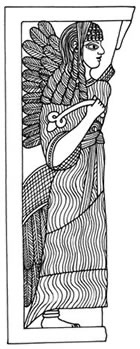
Female figure, a relief sculpture from a coffin. She wears a tunic and is wrapped from her hips down with folded wings, as Egyptian Isis and Nephthys are in funerary contexts. A veil, topped by an hawk’s head, an Egyptian motif, almost covers her hair. In her right hand she holds a small dove-shaped incense burner and in her left a bowl. Everything about her suggests that she was a priestess. From Carthage. Dated to the end of the fourth/beginning of the third century B.C. E.
Drawing © S. Beaulieu, after Moscati 1999: Plate 9.

From the Hebrew Bible, we know that Jezebel was a devotee of the Canaanite deities, especially the goddess Asherah, the main female deity of her Phoenician home state.[11] Like most royalty of the area, she would have been a high religious functionary of Sidon’s city deities, particularly Asherah. After her marriage, according to the Hebrew Bible, Jezebel influenced Ahab to become a worshiper of Baal (I Kings 17: 32). As queen of the northern kingdom of Israel, she supported functionaries of Canaanite polytheistic religions and fed four hundred prophets of Asherah at her table, as well as a large number of priests and, according to the Bible, “prophets” of Baal (I Kings 18: 19). The Bible also reports that she persecuted the prophets of the Israelite deity (I Kings 18: 4).

Opposition to Canaanite religion and to Jezebel was led by the prophet Elijah (I Kings 18: 17). On Mount Carmel, Elijah defeated the Baal prophets in a contest between their deity and his, and all the Baal prophets were killed (I Kings 18: 20-40). Jezebel then threatened Elijah with death, and he had to flee (I Kings 19: 1-2). Eventually Ahab was killed in battle (I Kings 22: 35), and later his son and successor, Joram, was treacherously slain by his ambitious general Jehu (II Kings 9: 22-24). Thus, Jezebel was left alone and vulnerable in Samaria, at the mercy of Jehu, now king of Israel (II Kings 9: 1-14), and a man who blamed her “countless harlotries and sorceries” for most of the problems of the land (II Kings 9: 22).

When Jehu arrived in the city, Jezebel must have known that she was close to death. So the Phoenician queen painted her eyes, dressed her hair, and stood at a window in the palace (II Kings 9: 30). Were the writers of the tale deliberately invoking the well-known motif of the “Woman in the Window”? Or is it possible that Jezebel was greeting her death proudly and defiantly, not only as a queen but also as a priestess of her goddess? It seems very likely.

Thus, the last Biblical picture of Jezebel, defiantly and bravely confronting her enemy from a window, might over time have added to negative interpretations of the “Woman at the Window” or vice versa. As Jezebel’s name later came to signify the worst kind of female depravity, so the goddess Kilili became a prostitute offering herself from a window.

Notes

  1. Assante also questions whether the word normally translated “prostitute” actually meant that.
  2. See her important discussion of prostitutes in the ancient Near East (Assante 2003: 33; 1998: 55, 57, 73-82).
  3. Or a priestess of the goddess, who would, for ceremonial occasions, would have incarnated her deity.
  4. My thanks to Professor Douglas Frayne of the University of Toronto for these translations and for giving me access to the results of his research on Kilili.
  5. Kilili was also a female demon who could cause diseases, as well as cure them.
  6. The mural crown represented city battlements on top of a wall and was the normal headdress of tutelary or protector goddesses of cities. Of course it was the model for the modern royal crown.
  7. The southern kingdom was Judah, where, after the fall of Israel, the Hebrew Bible took its final shape. This fact in part explains the Bible’s negativity towards the northern kingdom.
  8. “Windows of Appearances” were preserved in the excavated remains of Akrotiri on the Aegean island of Thera/Santorini (Marinatos [1984]: 12, plate 3).
  9. Probably Dumu-zi, Inanna/Ishtar’s lover, or an aspect of him. My thanks to Professor Douglas Frayne of the University of Toronto for information on this material.
  10. One of the epithets of the Greek goddess Aphrodite, who was identified with Astarte, was Parakyptousa, “Peeping Out (of a Window/Door).”
  11. Her name is theophoric or “god-bearing,” with the bel part referring to the storm god Baal.

Bibliography

  • Assante, Julia. 1998. “The kar.kid/[k]harimtu, Prostitute or Single Woman? A Reconsideration of the Evidence.” Ugarit-Forschungen 30: 5-96
  • Assante, Julia. 2003. “From Whores to Hierodules: The Historiographic Invention of Mesopotamian Female Sex Professionals.” Pp.13-47 in Ancient Art and Its Historiography. Edited by A.A. Donahue and M.D. Fullerton. Cambridge: Cambridge University Press
  • Boardman, John. 2006. The World of Ancient Art. London: Thames & Hudson
  • Hardin, Donald. 1963. The Phoenicians. Second edition. New York: Praeger
  • Lapinkivi, Pirjo. 2004. The Sumerian Sacred Marriage in the Light of Comparative Evidence. Helsinki: University of Helsinki Press. State Archives of Assyria XV
  • Lipinski, Édouard, editor. 1992. Dictionnaire de la civilization phénicienne et punique. [Turnhout, Belgium]: Brepols
  • Mallowan, (Sir) Max E.L. and Georgina Herrmann. [1974]. Furniture from SW.7 Fort Shalmaneser: Commentary, Catalogue, and Plates. London: British School of Archaeology in Iraq
  • Marinatos, Nanno. [1984]. Art and Religion in Thera: Reconstructing a Bronze Age Society. Athens: Mathioulakis
  • Moscati, Sabatino.1999 (1965). The World of the Phoenicians. London: Phoenix
  • Seibert, Ilse. 1974. Women in the Ancient Near East. New York: Schram
  • van der Toorn, Karel, Bob Becking, and Pieter W. van der Horst, editors. 1999. Dictionary of Deities and Demons in the Bible: Second Extensively Revised Edition. Leiden: Brill and Grand Rapids, MI: Eerdmans
  • Winter, Irene. 1987. “Women in Public: the Disk of Enheduanna, the Beginning of the Office of EN-Priestess, & the Weight of Visual Evidence,” 189-201 in Durand, J.-M., editor. La femme dans le Proche-Orient antique: Compte rendu de la XXXIIIe Rencontre Assyriologique Internationale (Paris, 7-10 Juillet, 1986). Paris: Editions Recherche sur les Civilisations

Graphics Credits

“Sacred Prostitutes”

Author: Johanna Stuckey, PhD
From the Archives of MatriFocus
A Cross-Quarterly Web Magazine for Goddess Women Near & Far
Samhain 2005, Vol 5-1


“Woman at the Window,” often interpreted as a prostitute, sacred or not, soliciting clients, but actually, in all likelihood, the Mesopotamian goddess Kilili, an associate or aspect of Inanna/Ishtar. One of many such ivory inlays of the same motif found in Mesopotamia, but probably made in Phoenicia/Canaan. Dated about 900 BCE.
Drawing © S. Beaulieu, after Shepsut 1993:115.

An “improbable percentage of the population [of Mesopotamia and Syria-Canaan] must have been either secular or religious prostitutes of some sort,” wrote Beatrice Brooks in 1941 (231). She was drawing conclusions from the writings of predominantly male scholars who accepted without question the concept of “sacred, cult, or temple prostitutes.” Female temple functionaries, they maintained, regularly engaged in sexual intercourse in return for a payment to their temples. Female devotees of Inanna/Ishtar, the Mesopotamian goddess of sexuality and love, were “immediately” suspect of such behavior (Assante 1998:6). Until recently, most scholars took this view for granted, and some still do.

In the nineteenth century, scholars thought Mesopotamia to be a hotbed of “naïve and primitive sexual freedom” (Assante 1998:5-6). Members of the then-new discipline of anthropology, such as Sir James Frazer of The Golden Bough fame, made matters worse by presenting for readers’ delectation the orgiastic rites of fertility cults (Assante 2003:22-24; Oden 2000:136-138). The result was a fertility-cult myth which took hold among scholars (Stuckey 2005:32-44; Assante 2003:24-25; Lambert 1992:136). A number of ancient sources were ultimately responsible for the concept of “sacred prostitute”: the Hebrew Bible; later Greek writers like Herodotus (ca.480-ca.425 BCE), Strabo (ca.64 BCE-19CE), and Lucian (ca.115-ca.200 CE); and early Christian churchmen. They greatly influenced later writers (Oden 2000:140-147; Assante 1998:8; Henshaw 1994:225-228; Yamauchi 1973:216).

Herodotus reported a “wholly shameful” custom by which every woman “once in her life” had intercourse near the temple of Aphrodite (Ishtar) with the first stranger who threw “a silver coin” into her lap (Herodotus 1983:121-122,I:199).[1] Similarly, Lucian described the punishment of women who declined to shave their heads in mourning for Adonis: “For a single day they [had to] stand offering their beauty for sale … [in a] market … open to foreigners only, and the payment [became] an offering to Aphrodite [Astarte]” (1976:13-15). The Christian writers accused pagans of indulging in orgies in honor of Aphrodite, ritual pre-marital sex, and “cult prostitution” (Oden 2000:142-144).

It is true that much ritual activity in the ancient Eastern Mediterranean focussed on promoting the fecundity of the land. In early Mesopotamia, for instance, the “Sacred Marriage,” with its fertility focus, could possibly have involved a “sacred prostitute.”


Canaanite dignitary with staff, possibly a priestess or queen. Ivory plaque carved on both sides. Probably a furniture inset. Pupils of eyes inlaid with glass. Megiddo, Israel. Dated about 1350-1150 BCE.
Drawing © S. Beaulieu, after Pritchard 1969:38, Fig. 125.

Webster’s English Dictionary defines a prostitute as, first, “… a woman who engages in sexual intercourse for money; whore; harlot”; second, “… a man who engages in sexual acts for money” (1996:1553). According to one scholar, “Cultic prostitution is a practice involving the female and at times the male devotees of fertility deities, who presumably dedicated their earnings to their deity.” The “Sacred Marriage” rite was one of “the motives of the practice, particularly in Mesopotamia,” where the king had intercourse with “a temple prostitute” (Yamauchi 1973:213).

Obviously, most scholars did not distinguish between ritual sex and sexuality for pay (Cooper forthcoming). However, ritual sex would not have been prostitution even if the act produced an offering for a temple (Lambert 1992:136). Rather, it would have been an act of worship.

In the Hebrew Bible, the word normally translated “sacred or cult prostitute” is qedeshah/qedeshot (feminine singular/ plural) and qadesh/qedeshim (masculine singular/plural). These four titles do not occur very often in the Hebrew Bible (Henshaw 1994:218-221).[2] The root qdsh means “set apart, consecrated” (Brown, Driver, and Briggs 1978 (1953):871-874).[3] For the most part, the terms occur in books from Deuteronomy through to II Kings, the so-called Deuteronomistic History, which is especially nationalistic, polemical, and denunciatory of Canaanite religion (Oden 2000:131,132; Olyan 1988:3). The assumption that “sacred prostitution” had not only occurred, but had happened in the context of fertility cults, resulted from the Hebrew Bible’s “deliberate” association of qedeshah, “sacred/consecrated woman,” with zonah, “prostitute” (Bird 1989:76).[4]


Seated North Syrian lady holding a goblet. Perhaps a priestess or a queen, who would also have been a priestess as a result of her queenship. Fragment of ivory carving found in Assyria, but probably made in Syria-Canaan.
Drawing © S. Beaulieu, after Shepsut 1993:168, fig.62.

Thus, an important category of cult functionary called qedeshah existed in Canaan (Henshaw 1994:235-236). Otherwise, why would the Bible need to discredit such women? Their function in Canaanite religion is not known, but they were “consecrated women,” probably priestesses.

When the archives of Ugarit, an ancient Semitic-speaking city in Syria, began to be interpreted, it quickly became evident that the religion of Ugarit was similar to the Canaanite religion vilified in the Hebrew Bible. Thousands of clay tablets dated to the Late Bronze Age, 1300-1200 BCE (Astour 1981:4), were found to contain, among other things, lists of gods, offerings, and religious functionaries (del Olmo Lete 1999; de Tarragon 1980). None of the priestly titles in the texts is grammatically in the feminine gender (de Tarragon 1980:7,8,139ff.), but they could have included women if the masculine form included the feminine, as it used to do in English.


Lady from Mari in northern Mesopotamia, now in Syria. Probably a priestess. Detail of main figure in a procession depicted in white shell inlay on slate. Found at Mari. Dated c.2600-2400 BCE. Drawing © S. Beaulieu, after Shepsut 1993:33, Fig. 7.

The word qdshm, “consecrated ones,” designated important functionaries: “… we find [them] listed second after the khnm `priests’ ” (Henshaw 1994:222-225; de Tarragon 1980:134,141; Yamauchi 1973:219). Qdshm had high status, could marry and establish families, and could hold other offices (de Tarragon 1980:141). There is no suggestion that the ritual role of the qdshm was sexual, nor, indeed, is there any evidence to date of “sacred prostitution” at Ugarit (de Tarragon 1980:139,140; Yamauchi 1973:219).

In Mesopotamian lists, the Semitic word kharimtu, usually translated “prostitute,” was often written with, or close to, the titles of female cultic personnel. As a result, the latter became “tainted” by proximity (Assante 1998:11). Thus not only qadishtu but other female cultic titles were translated “sacred or temple prostitute” (Assante 2003:32).

The Mesopotamian Semitic titles which have usually been translated as “sacred prostitute” include naditu, qadishtu, and entu (Oden 2000:148-150; Assante 1998:9; Lambert 1992:137-141). In general, naditu priestesses were high-status women who were expected to be chaste (Assante 1998:38-39; Henshaw 1994:192-195). At Sippar in Old Babylonian times (ca.1880-1550 BCE), they included royal and noble women (Harris 1960:109, 123ff.). There is no evidence that a naditu‘s duties included ritual sex (Oden 2000:148). The title qadishtu, “holy, consecrated, or set-apart woman,” has the same root as the Hebrew qedeshah (Assante 1998:44-45; Henshaw 1994:207-213). After scholars have carefully scrutinized “extensive evidence of [the qadishtu’s] cultic and other functions” (Gruber 1986:139), it is clear that the qadishtu was no “cult prostitute” (Oden 2000:149). Indeed, it is likely that most Mesopotamian priestesses, with one possible exception, were expected to be pure and chaste.


Enthroned lady, probably a high priestess, found in the Ishtar temple at Mari in northern Mesopotamia. Alabaster statue. Dated c.2600-2400 BCE.
Drawing © S. Beaulieu, after Shepsut 1993:33, Fig. 6.

The one exception might have been the entu, whom the Sumerians called Nin.Dingir “Lady Deity” or “Lady Who Is Goddess” (Henshaw 1994:47; Frayne 1985:14). If the “Sacred Marriage Rite” ever involved human participants, this priestess might, as “Inanna,” have had ritual intercourse with the king. However, the entu had very high status (Henshaw 1994:46) and, according to Mesopotamian law codes, had to adhere to “strict ethical standards” (Hooks 1985:13). Whatever else she was, she was not a prostitute.

For a certain period, the “Sacred Marriage” was an important fertility ritual in Mesopotamia (Frayne 1985:6). As a result of the king’s participation, whatever form it took, he became Inanna’s consort, sharing “her invaluable fertility power and potency” (Kramer 1969:57), as well as, to some extent, her divinity and that of her bridegroom Dumuzi. Unfortunately, no text tells us what happened in the temple’s ritual bedroom, not even whether the participants were human beings or statues (Hooks 1985:29). However, in a persuasive article, Douglas Frayne argues that, at least in early times, the participants were human: the king and the Nin.Dindir/entu (Frayne 1985:14).

In the “Sacred Marriage” material, the female participant is always called Inanna (Sefati 1998:305), so her human identity is obscured. That is not surprising, for I suspect that, during the ritual, the only female present was Inanna. What I am suggesting is that the Nin.Dindir/entu was a medium. Through talent and training, she went into a trance and allowed Inanna to take over her body. Then the goddess could actually be present during the ritual. To a greater or lesser degree, the king could similarly have embodied the god Dumuzi.


One of a large number of terracotta images of lovers on beds found in Mesopotamia. Often understood as connected to the “Sacred Marriage” rite, with the woman seen as a “sacred prostitute.” Dated to the third millennium BCE.
Drawing © S. Beaulieu, after Teubel 1984:117, Plate 19

A medium is “… a social functionary whose body only, the person’s awareness suppressed while in an ecstatic state, serves as a means for spirits to assist and/or communicate with members of the medium’s group in a positive manner” (Paper 1995:87). The “witch of Endor” in the Hebrew Bible (I Samuel 28:7-25) was likely a medium, and other ancient examples include the oracular priestesses through whom Apollo spoke at Delphi and the Maenad devotees of Dionysus (Kraemer 1989:49). Today mediums function in many religions: for instance, Chinese, Korean, African, and African-Christian of the Americas (Paper 1997:95,104-107,222-226,303; Sered 1994:181-193). Interestingly, the majority of contemporary mediums are female (Paper 1997:95).

Ancient Mesopotamia, like most other cultures, had its prophets and seers (Westenholz 2004:295). A number of them probably worked through trance. Indeed, “… ecstatic religious functionaries, that is, those whose religious functioning involves trance, are virtually ubiquitous in human cultures” (Paper forthcoming). So it would not surprise me to discover that the Inanna of the “Sacred Marriage” rite was actually properly named, for the goddess was using the body of a willing and devout ecstatic and priestess, who was certainly not a “cult prostitute.” On the contrary, she would have had extremely high status and have been deeply revered, for she was chosen of the goddess. Finally, then, the identity of the human female participant in the ritual is irrelevant. She was Inanna!

“Tragically,” says one contemporary scholar, “scholarship suffered from scholars being unable to imagine any cultic role for women in antiquity that did not involve sexual intercourse” (Gruber 1986:138). However, recent scholars are fast setting the record straight. Even if ancient priestesses were involved in ritual sex, even if they received offerings for their temples, they were not prostitutes but devotees worshipping their deity.

Notes

  1. On Herodotus’s “wholly shameful” Babylonian custom, Tikva Frymer-Kensky comments: “No cuneiform text supports the idea that the women of Assyria or Babylon did this.” She adds that Herodotus wanted to demonstrate “the superiority of Greeks” and, possibly, “to show the horrible results that could follow if proper women were not kept as guarded and secluded as they were in Greece”(Frymer-Kensky 1992:200). Significantly, late commentaries such as that of Herodotus are the “most explicit texts describing sacred prostitution in Mesopotamia” (Yamauchi 1973:216).
  2. For examples of qedeshah, see Gen.38:21-22, Dt.23:18; of qedeshot, see Hos.4:14; of qedesh, see Dt.23:18, 1K.22:46; of qedeshim, see 1K.14:24, 1K.15:12, 2K.23:7 The Jewish Publication Society translation of the Hebrew scriptures renders the female term “cult prostitute” and “prostitute,” the male term “cult prostitute” and “male prostitute”(Tanakh 1988).
  3. The King James Bible translates qedeshim as “sodomites.”
  4. Some scholars are even questioning the translation of term zonah as meaning “common prostitute, whore, harlot.” See Assante 2003:39, note 31.

Bibliography

  • Assante, Julia 1998. “The kar.kid/[kh]arimtu, Prostitute or Single Woman? A Reconsideration of the Evidence,” Ugarit-Forschungen 30:5-96
  • Assante, Julia 2003. “From Whores to Hierodules: The Historiographic Invention of Mesopotamian Female Sex Professionals,” 13-47 in Ancient Art and Its Historiography, edited A.A. Donahue and Mark D. Fullerton. Cambridge/New York: Cambridge University
  • Astour, Michael C. 1981. “Ugarit and the Great Powers” 3-29 in Ugarit in Retrospect: Fifty Years of Ugarit and Ugaritic, edited Gordon D. Young. Winona Lake, IN: Eisenbrauns
  • Bird, Phyllis 1989. “`To Play the Harlot’: An Inquiry into an Old Testament Metaphor,” 75-94 in Gender and Difference in Ancient Israel, edited Peggy L. Day. Minneapolis, MN: Fortress
  • Brooks, Beatrice A. 1941. “Fertility Cult Functionaries in the Old Testament,” Journal of Biblical Literature 60:227-253
  • Brown, F., S.R. Driver, and C.A. Briggs, editors 1978 (1953). A Hebrew and English Lexicon of the Old Testament…. Oxford: Clarendon
  • Cooper, J. S. forthcoming. “Prostitution,” Reallexikon der Assyriologie. 1932–. Founding eds. Erich Ebeling and Bruno Meissner. Berlin/Leipzig: de Gruyter
  • del Olmo Lete, Gregorio 1999. Canaanite Religion According to the Liturgical Texts of Ugarit. Bethesda, MD: CDL
  • de Tarragon, Jean-Michel 1980. Le Culte a Ugarit d’apres les textes de la pratique en cuneiformes alphabetiques. Paris: Gabalda
  • Frayne, Douglas 1985. “Notes on the Sacred Marriage Rite,” Bibliotheca Orientalis 42:5-22
  • Frazer, James G. 1981 (1890). The Golden Bough… Two Volumes in One. New York: Gramercy
  • Frymer-Kensky, Tikva 1992. In the Wake of the Goddesses: Women, Culture, and the Biblical Transformation of Pagan Myth. New York: Free
  • Gruber, Mayer I. 1986. “Hebrew Qedeshah and her Canaanite and Akkadian Cognates,” Ugarit-Forschungen 18:133-148
  • Harris, Rivkah 1960. “The Naditu Woman,” 106-135 in Studies Presented to A. Leo Oppenheim, edited E. Reiner. Chicago: University of Chicago
  • Harris, Rivkah 1961. “The Naditu Laws of the Code of Hammurapi in Praxis,” Orientalia n.s. 30:164-169
  • Harris, Rivkah 1975. Ancient Sippar: A Demographic Study of an Old-Babylonian City (1894-1595 B.C.). Istanbul: Historisch-Archeologisch Institut
  • Henshaw, Richard A. 1994. Female & Male, the Cultic Personnel: The Bible and the Rest of the Ancient Near East. Allison Park, PA: Pickwick
  • Herodotus 1983. The Histories, translated A. de Selincourt, revised A.R. Burn. New York: Penguin
  • Hooks, Stephen M. 1985. Sacred Prostitution in Israel and the Ancient Near East. Cincinnati, OH: Hebrew Union College Ph.D. dissertation, unpublished
  • Jewish Publication Society 1988. Tanakh, The Holy Scriptures: The New JPS Translation According to the Traditional Hebrew Text. New York: Jewish Publication Society
  • Kraemer, Ross S. 1989. “Ecstasy and Possession: Women of Ancient Greece and the Cult of Dionysus” 45-55 in Unspoken Worlds: Women’s Religious Lives, edited Nancy A. Falk and Rita Gross. Belmont, CA: Wadsworth
  • Kramer, Samuel N. 1969. The Sacred Marriage: Aspects of Faith, Myth and Ritual in Ancient Sumer. Bloomington, IN: Indiana University.
  • Lambert, Wilfried G. 1992. “Prostitution,” 127-157 in Aussenseiter und Randgruppen: Beitrage zu einer Sozialgeschichte des Alten Orients, edited V. Haas. Konstanz: Universitatsverlag
  • Lucian 1976. The Syrian Goddess (De Dea Syria), edited and translated H.W. Attridge and R.A. Oden. Missoula, MT: Scholars
  • Oden, Robert A., Jr. 2000 (1987). The Bible Without Theology. Urbana, IL: University of Illinois
  • Olyan, Saul M. 1988. Asherah and the Cult of Yahweh in Israel. Atlanta, GA: Scholars
  • Paper, Jordan 1995. The Spirits Are Drunk: Comparative Approaches to Chinese Religion. Albany, NY: State University of New York
  • Paper, Jordan 1997. Through the Earth Darkly: Female Spirituality in Comparative Perspective. New York: Continuum
  • Paper, Jordan forthcoming. “The Role of Possession Trance in Chinese Culture and Religion: An Overview from the Neolithic to the Present” in The People and the Dao: New Studies in Chinese Religion in Honor of Daniel L. Overmeyer, edited Philip Clart and Paul Crow. Monumenta Serica Monograph
  • Pritchard, James B. The Ancient Near East in Pictures Relating to the Old Testament. Second Edition with Supplement. Princeton, NJ: Princeton University, 1969
  • Safati, Yitschak 1998. Love Songs in Sumerian Literature: Critical Edition of the Dumuzi-Inanna Songs. Ramat Gan, Israel: Bar-Ilan University
  • Sered, Susan S. 1994. Priestess, Mother, Sacred Sister: Religions Dominated by Women. New York/Oxford: Oxford University
  • Shepsut, Asia. Journey of the Priestess: The Priestess Traditions of the Ancient World. A Journey of Spiritual Awakening and Empowerment. London: Aquarian/Harper Collins, 1993
  • Stuckey, Johanna H. 2005. “Ancient Mother Goddesses and Fertility Cults,” Journal of the Association for Research on Mothering 7/1: 32-44
  • Teubal, Savina J. Sarah the Priestess: The First Matriarch of Genesis. Athens, OH: Swallow/Ohio University, 1984
  • Webster’s Encyclopedic Unabridged Dictionary of the English Language 1996. Avenel, NJ: Gramercy Random House
  • Westenholz, Joan G. 2000. “King by Love of Inanna – an Image of Female Empowerment?” NIN 1:75-89
  • Westenholz, Joan G. 2004. “[Religious Personnel:] Mesopotamia” 292-295 in Religions of the Ancient world: A Guide, edited Sarah I. Johnston. Cambridge. MA: Harvard University Belknap
  • Yamauchi, Edwin M. 1973. “Cultic Prostitution: A Case Study in Cultural Diffusion,” 213-222 in Orient and Occident: Essays Presented to Cyrus H. Gordon, edited H. Hoffner. Neukirchen-Vluyn, Germany: Kevelaer

Graphics Credits

“Inanna and the Huluppu Tree”: One Way of Demoting a Great Goddess[1]

Author: Johanna Stuckey, PhD
From the Archives of MatriFocus
A Cross-Quarterly Web Magazine for Goddess Women Near & Far
Lammas 2005, Vol 4-4

gardener planting a sapling
Gardener Planting a Sapling at the Base of Another Tree in a Garden, with Wilderness Outside. From a relief vessel found at Mari. Steatite. Dated around 2500 B.C.E.
Drawing © S. Beaulieu, after Wolkstein and Kramer 1983:5

As a result of her control of fecundity and her centrality in the “Sacred Marriage,” Inanna kept her high standing among the Sumerian deities even as society increased in male-dominance (Wakeman 1985: 8). The poem “Inanna and the Huluppu Tree” gives a mythic explanation of how the throne and the bed used in the “Sacred Marriage” came into existence and, in the process, records a drastic demotion in Inanna’s status.[2]

Story

The poem begins at the beginning, “when what was needful had first come forth,” when bread first started to be baked in ovens of shrines, and when the first separation occurred, that of sky and earth (Frayne 2001:130; Wolkstein & Kramer 1983: 4). A violent storm uprooted a huluppu (poplar?) tree. Inanna rescued it and planted it in her “sacred grove” at Uruk (Frayne 2001: 131). She waited for it to get large enough to be made into a chair and a bed. Unfortunately, three creatures settled in the tree: in its roots “a snake which fears no spell”; in its trunk a lilitu, a female spirit; and in its branches the Anzu bird. Unable to rid herself of these intruders, tearful Inanna requested her brother Utu, the sun god, to help. He refused, but Gilgamesh, Uruk’s warrior king, did not. After the heavily armed hero “smote” the snake, the others fled. Gilgamesh cut down the tree, took the branches for himself, and gave the trunk to Inanna.

Analysis

Inanna rescued the huluppu tree at the time of beginnings, “when what was needful had first come forth.” Is it possible that the huluppu tree was among the “needful”? Perhaps the huluppu was the World Tree, which connects heaven, earth, and underworld (Campbell 1965: 486-89). In other mythologies, the World Tree usually has a serpent in its roots and often a bird in its branches (Campbell 1964: 41).

Anyway, the huluppu flourished in “pure Inanna’s fruitful garden” in the sanctuary at Uruk (Kramer 1967: 200; Shaffer 1963: 30, n.1). Many ancient precincts had sacred groves complete with sacred trees. In male-dominated Mesopotamia, a king usually held the title “Gardener” (Widegren 1951: 9, 11, 15). Indeed, gardening and plowing could be metaphors for taking the male part in sexual intercourse. For example, in one Sumerian love poem Inanna sings of her vulva, her “uncultivated land,” and asks, “Who will plow it?” Dumu-zi answers that he will plow it for her (Sefati 1998:224-225). Metaphorically, then, the fertile grove is the goddess, particularly her womb, her vulva. In the huluppu poem, however, the garden, the womb, was “fruitful” in and of itself. Inanna did no more than tamp the tree into place with her foot and water it with her foot! Clearly, her garden did not yet have a gardener, a plowman to plow it, to control its fertility. Not surprisingly, in a world where a gardener was beginning to be necessary for ordered and controlled cultivation, untended plants had to be incapable of normal progress. So the tree acquired what, in a male-dominated world (garden, womb), would have been considered parasites.[3]

If the huluppu was the World Tree, we would expect a serpent in its roots. Also, snakes had connections with earth and fecundity goddesses (Henshaw 1994: 173; Wolkstein & Kramer 1983: 3). Indeed, these beings of earth and underworld often lived under such goddesses’s shrines. Snakes are also boundary creatures, able to move in several elements. They often live at wells and springs, entrances to the netherworld.[4] From the roots the serpent “which fears no spell” could have connected with the underworld (Wolkstein & Kramer 1983: 180). Interestingly, Inanna tended the tree with her foot, her roots. Could the snake have been Inanna’s underworld self?

eagle-like bird with lion's head and outstretched wings
Probably the Anzu, an eagle-like bird with lion’s head and outstretched wings. Detail of a relief plaque from Girsu, Mesopotamia. Stone. Around 2450 BCE.
Drawing © S. Beaulieu, after Kramer and Wolkstein 1983:8.

The Anzu was an eagle-like, powerful bird-monster with a lion’s head. When it flapped its wings, it caused whirlwinds and other kinds of storms. Inanna may also have had some connection with storms, making the bird’s presence understandable (Williams-Forte 1983: 180, 194; Wolkstein & Kramer 1983: 95-96, 102; Jacobsen 1976: 136-137). In the branches of Inanna’s tree, the bird was also at the boundary between earth and sky. It too was able to move across thresholds. Is it possible that the Anzu was Inanna’s heavenly self?

From Mesopotamian writings going back into the third millennium BCE comes evidence of spirits like the one in the tree trunk (Hutter 1995: 973).[5] She was a member of the lilu family of demons (feminine lilitu) (Chicago Assyrian Dictionary 1956). Lilu demons manipulated “stormy winds,” and the lilitu could fly like a bird. They also had negative sexual characteristics, especially the females. Unmarried, they roamed about looking for men to ensnare, and they got into buildings through windows. More important, lilu sexuality was not “normal,” so that men could not have sex with lilitus in the way they did with their wives (Hutter 1995: 973).

The lilitu sounds very much like Inanna and Ishtar, Inanna’s Semitic counterpart. Ishtar “stands at the window looking for a man in order to seduce him, love him and kill him” (Hutter 1995: 973-4). Inanna too displayed herself provocatively in windows and doors (Jacobsen 1976: 140), and, like Ishtar, she was called “sahiratu, ‘the one who roams about.'” In hymns she goes “from house to house and street to street,” a phrase later used to describe demons (Frymer-Kensky 1992: 28).

Such paralleling of independent women and demons suggests that, in increasingly patriarchal culture, Inanna’s independence was slowly being isolated from her other characteristics, and the hard-to-assimilate independence was assigned to two separate functions: prostitute and demon. The prostitute was useful, if marginalized, and the demon was feared and rejected. The fact that many translators render the word lilitu as “Lilith” may indirectly support such a theory (Kramer 1967: 200; Wolkstein & Kramer 1983: 6). The lilitu was antecedent to Lilith, the first wife of Adam, vilified in later Jewish texts (Ausubel 1979: 393-4; Graves & Patai 1964: 68).

winged goddess with lions and owls
Queen of Heaven, Earth, and the Underworld, almost certainly the Goddess Inanna/Ishtar. Terracotta relief. Dated around 2000 B.C.E.
Drawing © S. Beaulieu, after Neumann Plate 126

According to Raphael Patai, an image on a Babylonian baked-clay plaque, dated as “roughly contemporary with the [huluppu-tree] poem,” depicts a lilitu (Patai 1990: 222 & Plate 31; Wolkstein & Kramer 1983: 6). He thought that the nude figure, standing on lions and flanked by owls, was a night goddess and lady of wild animals. However, she wears the multi-horned crown and carries the ring-and-rod symbol of power (Henshaw 1994: 240; Williams-Forte 1983: 181; Jacobsen 1976: 38). She is most unlikely to be merely a lilitu. Rather she is the goddess Inanna with the wings and the death-dealing talons of an owl (?), perhaps indicating a connection with the netherworld (Williams-Forte 1983: 189). This suggestion gains support from a cylinder seal dated 2000-1600 BCE.[6] The head of a winged goddess with many-horned crown reaches its top register, and her clawed feet are firmly planted in the bottom one. Above the line are deities and human worshipers, while below it are “demonic creatures.” Some scholars interpret this winged goddess as Lilith and so a lilitu, but she too is probably Inanna (Williams-Forte 1983: 189; Wolkstein & Kramer 1983: 51). This seal provides another part of Inanna’s nature. Not only does its arrangement present the goddess’s duality — of both of the upper world and the underworld — but it suggests that she joins the two. Like the huluppu tree, she stands with feet, roots, in the underworld and head, branches, in the heavens, her body, the trunk, joining them. She herself could be interpreted as the “cosmic tree of life” and death (Campbell 1965: 64).

When Gilgamesh had disposed of the huluppu tree’s inhabitants, he uprooted it, thus eliminating, finally, any natural connection between earth and underworld.[7] He then gave the wood to Inanna to make into a bed and a throne, the furniture used in the “Sacred Marriage.” However, the furniture, which was essentially constructed from her body, was no longer entirely hers. The institution of kingship had appropriated it and, with the furniture, Inanna herself. What is more, the poem presents her as willingly co-operating in her own demotion. Both she and the furniture would henceforth serve a male monarchy in a male-dominated society. In this way, society was able to circumscribe her and direct her undoubted power into channels that would be useful to the male-dominated city.

sacred tree, horned goddess, priest(ess)
Sacred Tree, Horned Goddess, and Priest(ess). Cylinder seal impression. Dated about 2330-2150 B.C.E.
Drawing © S. Beaulieu, after Wolkstein and Kramer 1983: 3.

Inanna was now goddess only of the heavens and the earth, and the cycle of life had suffered irreparable damage. The destroying of the huluppu tree meant that human beings could no longer count on Inanna and the World Tree to maintain the cycle of life and death. Instead, they were now facing a terrifying, linear world. The old cyclical understanding of death as merely one stage in the eternal round of birth, death, and renewal, symbolized by the tree, had been replaced by a linear perception of life with death and the underworld as the end (Kovacs 1989:59-75; Wolkstein & Kramer 1983:51-89).

The seemingly innocent poem “Inanna and the Huluppu Tree,” then, constitutes an androcentric account of the reasons for Inanna’s involvement in the “Sacred Marriage,” both as herself and as furniture. It shows well how myth can be remade to serve ideology! A powerful goddess subject, the sacred World Tree, had, over the centuries, been reshaped into limited goddess objects, a bed and a throne, while the goddess herself was co-opted into seeing this limited role as powerful. Independent Inanna had become feminine, a woman reliant on males to get her out of trouble. The extant poem probably echoes an earlier story, one in which Inanna and the World Tree had very different roles. We can only imagine what they were.

Notes

  1. This column represents a shortening, rewriting, and updating of my article on the same topic which appeared in Feminist Poetics of the Sacred: Creative Suspicions, eds. Frances Devlin-Glass and Lyn McCredden. Oxford: Oxford University Press, 2000. Pages 91-105.
  2. The Huluppu Tree poem is part of the Sumerian tale known as “Gilgamesh, Enkidu, and the Netherworld” (Frayne 2001:129-143).
  3. Elsewhere in Mesopotamian myth, a goddess who created alone without the assistance of a male partner gave birth only to aberrations: Ti’amat, who, with her male consort Apsu, produced all the other gods, gave birth to only monsters after her consort’s demise (Heidel 1967: 23-4, lines 132-45). This pattern also occurs in mythologies of other cultures, for example, that of ancient Greece: When Hera, Queen of Heaven, bore a child not fathered by her husband Zeus and perhaps even unfathered, she gave birth to the physically deformed Hephaistos.
  4. For example, the snake who stole the plant of youth from Gilgamesh lived in or near a spring (Foster 2001: 94-95).
  5. The Sumerians called her ki-sikil-lil-la, in Semitic Akkadian, (w)ardat-lilla or ardat-lili; both phrases mean “Young Woman Spirit” (Douglas Frayne, personal communication, 10 December 1996).
  6. A drawing of this seal was published in the Beltane issue, 2005.
  7. It is ironic that Gilgamesh was the hewer-down of the huluppu tree, for, in the Epic of Gilgamesh, he is so appalled by death and the netherworld that he undertakes a quest for immortality (Foster 2001).

Bibliography

  • Ausubel, Nathan, ed. 1979. A Treasury of Jewish Folklore. New York: Crown.
  • Campbell, Joseph 1965. The Masks of God: Occidental Mythology. New York: Viking.
  • Campbell, Joseph 1964 (1949). The Hero with a Thousand Faces. NY: Meridian..
  • Chicago Assyrian Dictionary 1956. Chicago: University of Chicago.
  • Foster, Benjamin R., translator/editor. 2001. The Epic of Gilgamesh. New York: Norton.
  • Frayne, Douglas, translator/editor 2001. “Gilgamesh, Enkidu, and the Netherworld,” 129-143 in The Epic of Gilgamesh, translator/editor B.R. Foster. New York: Norton.
  • Frymer-Kensky, Tikva 1992. In the Wake of the Goddesses: Women, Culture, & the Biblical Transformation of Pagan Myth. New York: Free Press.
  • Graves, Robert & Raphael Patai 1964. Hebrew Myths: The Book of Genesis. London: Cassell.
  • Heidel, Alexander, translator 1967 (1951). The Babylonian Genesis: Second Edition. Chicago: Phoenix Books, University of Chicago.
  • Henshaw, Richard A. 1994. Female & Male, the Cultic Personnel: The Bible & the Rest of the Ancient Near East. Allison Park, Penn.: Pickwick.
  • Hutter, M. 1995. “Lilith.” 973-976 in Dictionary of Deities & Demons in the Bible, edited Karel van der Toorn et al. Leiden: Brill.
  • Jacobsen, Thorkild 1976. The Treasures of Darkness: A History of Mesopotamian Religion. New Haven, CT: Yale University.
  • Kovacs, Maureen Gallery, translator 1989. The Epic of Gilgamesh. Stanford: Stanford University.
  • Kramer, Samuel Noah 1967 (1963). The Sumerians: Their History, Culture, & Character.. Chicago: University of Chicago.
  • Neumann, Erich 1970 (1955). The Great Mother: An Analysis of an Archetype. Princeton, NJ: Princeton University, Bollingen.
  • Patai, Raphael 1990. The Hebrew Goddess: Third Enlarged Edition. Detroit: Wayne State University.
  • Sefati, Yitschak 1998. Love Songs in Sumerian Literature: Critical Edition of the Dumuzi-Inanna Songs. Ramat Gan, Israel: Bar-Ilan University.
  • Shaffer, Aaron 1963. Sumerian Sources of Tablet XII of the Epic of Gilgamesh. Philadelphia: University of Pennsylvania PhD Dissertation (University Microfilms 1974).
  • Wakeman, Mary K. 1985. “Ancient Sumer & the Women’s Movement: The Process of Reaching Behind, Encompassing & Going Beyond,” Journal of Feminist Studies in Religion 1/2:7-27.
  • Widegren, George 1951. The King & the Tree of Life in Ancient Near Eastern Religion. Uppsala: Lundquist.
  • Williams-Forte, Elizabeth 1983. “Annotations of the Art,” 174-199 in Inanna, Queen of Heaven & Earth: Her Stories & Hymns from Sumer edited/translated Diane Wolkstein and Samuel N. Kramer. New York: Harper Colophon.
  • Wolkstein, Diane and Samuel Noah Kramer editors/translators 1983. Inanna, Queen of Heaven & Earth: Her Stories and Hymns from Sumer. New York: Harper Colophon.

Graphics Credits

Inanna’s Descent to the Underworld[1]

Author: Johanna Stuckey, PhD
From the Archives of MatriFocus
A Cross-Quarterly Web Magazine for Goddess Women Near & Far
Beltane 2005, Vol 4-3


Between mountains containing monsters and deities and perhaps representing the underworld, a goddess (Inanna?) holds a ring. Could it be the one taken from Inanna at a gate of the underworld? Mesopotamian cylinder seal. Hematite. Around 2330-2150 BCE.
Drawing © S. Beaulieu, after Wolkstein and Kramer 1983:57

From the great heaven [great above] she set her mind on the great below. From the great heaven the goddess set her mind on the great below. From the great heaven Inana[2] set her mind on the great below. My mistress abandoned heaven, abandoned earth, and descended to the underworld.
(Black, Cunningham, et al. 1998-2000:1 of 8)

Story

Before she left for the underworld, Inanna put on her divine regalia and took up “the appropriate divine decrees [me]” (Kramer 1972:86). She instructed her minister Ninshubur that, after three days, she was to ask help of the great gods. At each of the seven gates of the underworld, Inanna removed part of her regalia, until, naked and bent, she came before the seven judges of the underworld and her elder twin-sister Ereshkigal, whose name means “Queen of the Great Earth.” All gave her “the look of death,” and they had her dead body hung on a hook.

Three days later, Ninshubur began to seek help, but neither the chief god nor the moon god, Inanna’s father, was sympathetic. However, the god of wisdom instructed two creatures to sprinkle over Inanna’s corpse both a life-giving plant and life-giving water.

When the creatures sympathized with Ereshkigal, who was groaning in misery, she offered them rich rewards, but they asked only for the corpse on the peg. They sprinkled it, and Inanna lived again. However, before the judges would let her leave the great below, they insisted she provide a substitute, and so demons ascended with her to bring her substitute back. Inanna refused to give them several faithful servants, but she surrendered her bridegroom Dumuzi because he was not in mourning for her. For a while Dumuzi escaped the demons, but finally they carried him off. Then Inanna mourned for him. Finally, Dumuzi’s sister arranged to take his place in the underworld for part of each year (Black, Cunningham, et al. 1998, 1999, 2000: 1-8).[3]

Dumuzi feeding sheep
Man in net skirt (Dumuzi?) feeding sheep. Inanna’s standards (“gateposts”) that frame the image suggest that the event is happening inside her temple grounds. Mesopotamian cylinder seal. Marble. About 3200-3000 BCE.
Drawing © S. Beaulieu, after Wolkstein and Kramer 1983:85

Interpretation

When Inanna arrived at the first gate, she demanded entrance, telling the gatekeeper she had come to attend her brother-in-law’s funeral. Kramer, followed by other scholars, considered this excuse “false” (1981:157); so they advanced various explanations of Inanna’s decision. Joseph Campbell saw her as going to meet her opposite (1964:105-109), Kramer judged her as longing for “still greater power” (1981:156), and Lipinkivi thought she went “to deprive her sister, Eres[h]kigal, of her powers” (2004:190). Feminist discussions of the poem include Perera’s Jungian interpretation (1981) and Diane Wolkstein’s, who viewed Inanna as searching for knowledge (1983:156).

“Inanna’s Descent” took its final written form after years of recopying in a male-dominated religion, and, during that time, it is probable that Inanna slowly changed. Visual as well as written material[4] from Sumer persuades me that originally Inanna had the right to visit the underworld as part of her realm. For instance, a Babylonian seal depicts a winged female with high, horned crown and bird feet, standing with her head among “deities and their human worshippers” and her feet among “demonic creatures.”

Winged goddess Inanna with deities and devotees
A winged goddess wearing a multi-horned crown stands with her head in the realm of the deities and their devotees. Her bird-clawed feet rest in a place, likely the underworld, inhabited by strange and demonic creatures. Some think her to be Lilith, but the crown shows her to be a great goddess, almost certainly Inanna. Mesopotamian cylinder seal. Hematite. 2000-1600 BCE.
Drawing © S. Beaulieu, after Wolkstein and Kramer 1983: 51.

This dominating goddess may be Inanna, and the “hierarchical arrangement” perhaps indicates “her dual nature, partially of ‘heaven and earth’ and partially of the underworld” (Williams-Forte in Wolkstein and Kramer 1983:189). In addition, the fact that Ereshkigal and Inanna were sisters may indicate that they could once have been a single goddess.[5] This suggestion may explain not only Inanna’s decision, but also her assertiveness at the first gate.[6]

By the time the poem reached the form in which it has come down to us, death seems no longer an accepted part of the cycle of life. Instead, it was terrifying, to be avoided, since it led to a dreary existence in the Land of No Return (Foster 2001:138-142). Further, it seems likely that only in a culture that feared death and the underworld would there be enmity between deities of the great above and the great below, as there seems to have been between Inanna and Ereshkigal. Now not even a goddess could enter the underworld without being humiliated, stripped of means, abject, and naked.

When Inanna protested the removal of her regalia, the gatekeeper told her to be quiet: “Be satisfied, Inana, a divine power of the underworld has been fulfilled. Inana, you must not open your mouth against the rites of the underworld.” During her descent, Inanna lost in order: crown (queenship?), precious necklace (charisma, glamour?), two oval stones (birthing ability or femaleness?), breastplate “Come, man, come” (sexual allure), gold ring (her seal, her signature?), rod and measuring line (authority), and “garment of ladyship” (robe of deity). Everything that signified her status and identity disappeared. Some translators understand the naked Inanna as forcing Ereshkigal to relinquish the throne to her; others have Ereshkigal retaining the throne.[7]Nevertheless, Inanna became a corpse.

Significantly, in this poem from a male-dominated society, Inanna could return to the great above only with the help of a male deity, as she had clearly known when she instructed her minister to appeal to several of them. The god of wisdom hatched the plan to free Inanna and created from dirt under his fingernails two ghostly, fly-like creatures, so like the denizens of the underworld that they could pass the gates unnoticed. They were to get Ereshkigal to release Inanna’s corpse to them.[8] All went as planned: they sprinkled the corpse with the life-giving substances, and Inanna came alive again.

Surprisingly, the Sumerian poem does not mention a decrease in fertility on earth during Inanna’s absence even though fertility was supposedly her concern.[9] It is also curious that, while Inanna’s corpse was hanging on the peg, her sister Ereshkigal was lying moaning, seemingly in the act of giving birth or after doing so: “The mother who gave birth, Erec-ki-gala [Ereshkigal], because of her children, was lying there.” Was Ereshkigal, not Inanna, the source of fertility?

To reward the creatures who commiserated with her, Ereshkigal offered them “a river with its water,” which they refused, and “a field with its grain,” which they also refused. Not only could Ereshkigal give away river water, but she could also offer grain! In Mesopotamia, river water was life, fertility, for it irrigated the fields in which grew the grain that people depended on. So, here, fertility came from the underworld; life-giving rivers flowed out of it, and seemingly dead seed placed under the earth’s surface produced new life.

In the poem, there is a connection, at least of proximity, between Ereshkigal’s sickness and Inanna’s revival. Ereshkigal appeared to be suffering from birth pains. Was Ereshkigal birthing Inanna? Was Inanna’s body the seed of her revived self? All a seed seems to need to become new life is water and nourishment, water and plant. Was it then Ereshkigal who brought new life into the world? She seemed to have some control of seed. Were the dead in the underworld seeds of new life? Is this poem preserving a remnant of an earlier cyclical attitude to life?[10]

Inanna welcomes Dumuzi back from the Underworld
Goddess with multi-horned crown (Inanna?) welcomes a mace-holding and crowned god who emerges from the base of a tree (Dumuzi?). Mesopotamian cylinder seal. Serpentine. About 2320-2150 BCE.
Drawing © S. Beaulieu, after Wolkstein and Kramer 1983:40.

According to the rules of the underworld, when one went there, one did not return, unless, of course, one were a goddess and could provide a substitute, as Inanna eventually did when she turned “the look of death” on her bridegroom Dumuzi! From then on, Inanna stayed above as queen of heaven and earth and left the underworld to her sister Ereshkigal. Her substitute, Dumuzi undertook the cyclical visits on Inanna’s behalf. Luckily for Dumuzi, who is the first in a long line of Eastern Mediterranean male deities (“Dying Gods”) who disappear and return, he too provided a substitute, his devoted sister.

The poem ends: “Holy Erec-ki-gala [Ereshkigal] — sweet is your praise.” This ending makes one wonder whom the poem is really about. Perhaps it is not primarily about the queen of heaven, but about the queen of the underworld. There is no doubt that, as soon as Inanna entered the underworld, Ereshkigal was in charge, in her realm. She also seemed to be involved in fertility and bringing to birth. Perhaps we are dealing here with an underworld that still retained elements of a cyclical view of life and nature. In addition, the underworld was the source not only of new life, rebirth, but also of the riches of the earth, in an agrarian culture, the crops.[11] The crops grow from seemingly dead seeds deposited in the earth and seemingly decaying before bringing forth new life. Is Inanna’s descent a planting metaphor?

As I interpret it, “The Descent of Inanna” is a possible patriarchalization of a pre-patriarchal story of a deity connected with fertility who disappears and returns, a story that affirms the cyclicity of the round of life and death. Farming cultures understand the cycle and accept it. Beginning her descent, Inanna anticipated problems; maybe she suspected that things had changed. One of the main changes, I suggest, was that Ereshkigal, probably originally Inanna’s underworld aspect, had now taken on a personality of her own. And she was not particularly welcoming to her counterpart from the great above.

Later, even Ereshkigal’s hold on the underworld would be broken forever when she encountered the young macho god Nergal, a minor deity. Arrogant and bad-mannered, Nergal insulted Ereshkigal’s messenger/ambassador. Furious, she demanded his life. Then, properly briefed by the god of wisdom, he descended to the underworld and violently overpowered the goddess. When he was about to behead her, she offered him marriage and rule over her realm. His reaction was exceedingly macho:

He listened to her, picked her up, kissed her and wiped away her tears, saying — in sudden enlightenment; “It was but love you wanted of me from months long ago to now!”
(Jacobsen 1976: 229)

In an even later version Nergal descended to the underworld when Ereshkigal demanded his life. Instead of killing him, she took him to her bed. After seven days, he made off! Ereshkigal demanded that the gods send him back to marry her because she was now “impure” and could no longer be a proper judge. Nergal returned — as king of the underworld (Jacobsen 1976:230). To what depths had this great goddess been brought!!

My interpretation of the “Descent of Inanna” poem is, of course, speculative. Yet, the poem has many elements that show that it is one that has undergone change. Perhaps originally it was a poem in praise of a goddess who combined the characteristics and realms of Inanna and Ereshkigal, she who was the source of all becoming, the reason why the cycles rolled back on themselves and the world continued.

Notes

  1. According to Samuel Noah Kramer, “Inanna’s Descent” was available in fourteen tablets and fragments (1972:84). He “reconstructed and deciphered” the poem over a six-year period (1972:83). See also Kramer in Wolkstein and Kramer 1983:127-135.
  2. Recent scholarship uses this spelling (Bienkowski and Millard 2000:152; Black and Green 2003 [1992]:108).
  3. Except where indicated otherwise, I use this translation throughout.
  4. The next column will discuss this poem, “The Huluppu-Tree” (Wolkstein and Kramer 1983: 4-9).
  5. Lapinkivi states that Ereshkigal “can be seen as deriving from Inanna/Ishtar” and that an Assyrian version of the poem, “Ishtar’s Descent,” names Ereshkigal Ishtar “who resides in the midst of Irkalla [the underworld]” (2004:179).
  6. In the Semitic version, Ishtar threatens the gatekeeper with violence (Pritchard 1969:107, Speiser translation). Also see Pritchard for Kramer’s translation of the Sumerian version (53-57).
  7. In the Semitic version, at first sight, Ishtar attacks Ereshkigal (Pritchard 1969:108)
  8. In the Semitic version, the god of wisdom created a beautiful eunuch to beguile Ereshkigal (Pritchard 1969:108).
  9. In the Semitic version, Ishtar’s disappearance causes fertility to cease on earth (Pritchard 1969:108).
  10. I am not necessarily suggesting reincarnation here, but understanding the dead as the fertilizing stuff of renewal in a cyclical process.
  11. As in ancient Greece, where Plutos, an underworld deity, was god of riches, and the dead were called Demetrioi, those of Demeter, the goddess of grain — Demeter’s daughter Persephone was the only deity who could cross the threshold in and out of the underworld. She was both seed and new sprouts.

Bibliography

  • Bienkowski, Piotr and Alan Millard, ed. 2000. Dictionary of the Ancient Near East. Philadelphia: University of Pennsylvania.
  • Black, Jeremy and Anthony Green 2003 (1992). Gods, Demons and Symbols of Ancient Mesopotamia: An Illustrated Dictionary. Austin, TX: University of Texas.
  • Black, Jeremy, Graham Cunningham, Eleanor Robson and Gabor Zlyomi, transl. 1998, 1999, 2000. “Inana’s Descent to the Nether World: Translation,” 1-8, downloaded February 2005 from web site <http://www.piney.com/InanasDescNether.html>
  • Campbell, Joseph 1964 (1949). The Hero with a Thousand Faces. NY: Meridian..
  • Foster, Benjamin R., transl. and ed. 2001. The Epic of Gilgamesh. NY: Norton
  • Jacobsen, Thorkild 1976. The Treasures of Darkness: A History of Mesopotamian Religion. New Haven, CT: Yale University.
  • Kramer, Samuel Noah 1981 (1956). History Begins at Sumer: Thirty-Nine Firsts in Recorded History. Philadelphia: University of Pennsylvania.
  • Kramer, Samuel Noah 1972 (1961). Sumerian Mythology: A Study of Spiritual and Literary Achievement in the Third Millennium B.C .Philadelphia: University of Pennsylvania.
  • Lapinkivi, Pirjo 2004. The Sumerian Sacred Marriage in the Light of Comparative Evidence. Helsinki: University of Helsinki, State Archives of Assyria Vol. XV.
  • Perera, Sylvia 1981. Descent to the Goddess: A Way of Initiation for Women. Toronto: Inner City.
  • Pritchard, James B., ed.1969. Ancient Near Eastern Texts Relating to the Old Testament. Third Edition with Supplement. Princeton, NJ: Princeton University.
  • Wolkstein, Diane and Samuel Noah Kramer 1983. Inanna, Queen of Heaven and Earth: Her Stories and Hymns from Sumer. NY: Harper & Row.

Graphics Credits

Inanna, Goddess of “Infinite Variety”

Author: Johanna Stuckey, PhD
From the Archives of MatriFocus
A Cross-Quarterly Web Magazine for Goddess Women Near & Far
Samhain 2004, Vol 4-1


Enheduanna in full regalia supervising ritual at altar before temple tower. Limestone disk, from Ur, ca.2300 BCE, restored.
Drawing @ S. Beaulieu, after Meador 2000:38,13a.

“The Amazement of the Land [of Sumer],”[1] Inanna was a powerful and assertive goddess whose areas of control and influence included warfare, love/sexuality, and prosperity/fertility. As “Lady Who Ascends into the Heavens,” she was the Venus Star. One of her regular epithets was “the maiden,” and her usual roles — little sister and pert daughter, sweetheart, nubile bride, and grief-stricken young widow — all present her as in late adolescence, permanently poised on the edge of full womanhood, not yet tied down by wifehood. It is no surprise, then, that Inanna was a female who behaved like a male and lived “essentially the same existence as young men,” exulting in battle and seeking sexual experiences (Frymer-Kensky 1992:29). In addition, Mesopotamian texts normally refer to her as “the (or a) woman,” and, even when they call her “warrior,” she is still “the woman” (Stuckey 2001:92).[2]

The great American scholar of Sumer and things Sumerian Samuel Noah Kramer described Inanna as “…the ambitious, aggressive and demanding goddess of love …” (1963:153). In historic times, she certainly was goddess of love and sexuality, but she also held and could bestow the mes, the attributes of civilization.[3] Thus, she ruled over many areas of culture. According to Thorkild Jacobsen, these included “the storehouse” (1976:135), “the rains” (136), “war” (137), “Morning and Evening Stars” (138), and what he calls “harlotry,” prostitution (Jacobsen 139). Of Inanna, he says:

In the epics and myths, Inanna is a beautiful, rather willful young aristocrat. We see her as a charming, slightly difficult younger sister [to her Sun God brother], as a grown daughter [of her Moon God father]…, and a worry to her elders…. We see her as a sweetheart, as a happy bride, and as a sorrowing young widow. We see her, in fact, in all the roles a woman may fill except the two which call for maturity and a sense of responsibility. She is never depicted as a wife and helpmate or as a mother.(Jacobsen 1976: 141)[4]

This description of Inanna includes many of her aspects, but all the roles that Jacobsen discusses are ones that attach a woman to males by means of the patriarchal family and so control her sexuality and ability to reproduce. Feminist scholar Tikva Frymer-Kensky understands Inanna differently: Inanna was the divine model for a role that was not considered socially desirable. “She represents the non-domesticated woman, and she exemplifies all the fear and attraction that such a woman elicits” (1992: 25). She is a woman who is not tied to the patriarchal family, whose sexuality is not controlled for its ends. In addition, Inanna is the fearsome spirit of “the attraction necessary for all sexual copulation, regardless of its social purpose or value.” Nonetheless, despite being the goddess of prostitutes, Inanna was, as goddess Ishara, also “patron of marital sexuality” (47-48).


Rain goddess, possibly Inanna-Ishtar, holding streams of rain and standing on the storm god’s lion-bird. Shell cylinder seal. Akkadian, ca. 2334-2154 BCE.
Drawing © S. Beaulieu, after Wolkstein & Kramer 1983:94

Whereas Inanna seems to have been the foremost female deity of the male-dominated Sumerian culture, a similar goddess Ishtar was worshipped by Semitic-speaking peoples to the north (Kramer 1983: 115, 123). From early times, Inanna and Ishtar became increasingly identified, until, by the period of Sargon the Great (about 2300 BCE), they were so similar that, in discussing them, scholars usually treat them as one deity — Inanna-Ishtar. Slowly, Inanna in her “infinite variety” gave way to Ishtar, whose primary functions were love/sexuality and war. Finally, with the first-millennium Assyrians and later, only Ishtar remained. We can still see remnants of Inanna in later Ishtar, but, in her final form, Ishtar seems a very different goddess.

Some argue that the identification of the two goddesses was partly the result of a policy of Sargon the Great, the Semitic-speaking ruler of Agade, biblical Akkad, who had conquered Sumer and most of western Asia (Kramer 1983:117). For a time, he managed to unite the whole of Mesopotamia under his rule (Meador 2000: 41). To help him control “the restless and rebellious populations of the southern Sumerian cities” (Meador 2000: 49), Sargon appointed his accomplished daughter Enheduanna as high priestess and thus spouse of the moon god Nanna, tutelary deity of Ur, one of Sumer’s most important cities. For over forty years, she held this priestly office (Meador 2000:6). On the back of the now-famous disc found in the 1920s inside the Nanna complex near the residence of Ur’s high priestess, an inscription names Enheduanna as “wife of Nanna, daughter of Sargon” and dedicates the disc to Inanna (Meador 2000:37). As incumbent of an ancient and revered office, Enheduanna wielded great power among the Sumerians (Meador 2000:49). However, she is remembered today primarily as a great poet, indeed as the first poet in history whose name we know. The forty-two poems she wrote to temples throughout the area “spread her influence and her beliefs …” (Meador 2000: 50). Further, her three poems to the goddess Inanna “effectively defined a new hierarchy of the gods” and helped Sargon by identifying Inanna and Ishtar (Meador 2000:51). During the period when the Semitic-speaking Akkadians controlled Mesopotamia (2334-2154 BCE), the melding of Inanna and Ishtar continued (Williams-Forte1983:189).

Inanna’s symbols appear on some of the earliest Mesopotamian seals (Adams 1966:12), and she is the first goddess about whom we have written records (Hallo & Van Dijk 1968). However, it is clear that she did not spring into existence with the invention of writing. Throughout Mesopotamia, archaeologists have found a large number of female figurines, dating from as early as the sixth millennium BCE. Some, which may be forerunners of Inanna, display prominent breasts and have their hands under or cupping them, a gesture employed by many later goddesses, among them Inanna. In Symbols of Prehistoric Mesopotamia, Beatrice L. Goff traced Mesopotamian symbols from Neolithic times into the historical period. From her study of various symbols and figurines, she concluded that the main concern of the early Mesopotamians was fertility (1963: 21), later one of Inanna’s special interests.

In historic times, the sacred animal of Inanna-Ishtar was the lion, which the goddess usually stood on or otherwise controlled. Often winged, Inanna-Ishtar also had close association with birds, like the thunderbird and especially the owl (Lipinkivi 2004: 140). As queen or lady of the sky, she was the Morning and Evening Stars, the planet Venus, and, as daughter of the moon god, Inanna also had connections to both the crescent and the full moon (Lapinkivi 2004: 60,111). An unmistakable symbol of Inanna-Ishtar was the eight-pointed star or rosette, which signified her identification with the planet Venus (Williams-Forte 1983:187). A significant symbol of Inanna was a pair of standards, usually called gateposts, which appeared very early in the archaeological record (Goff 1963:84). The standards signaled both the presence of the goddess and the entrance to her temple (Williams-Forte 1983:188; Wolkstein & Kramer 1983: 47, 106).


Triumphant Inanna-Ishtar, winged, with foot on her roaring lion and star symbol, being worshipped by a lesser goddess. Black-stone cylinder seal. Akkadian, ca. 2334-2154 BCE.
Drawing © S. Beaulieu, after Wolkstein & Kramer 1983:92

Inanna’s paramount city in Mesopotamia was Uruk, one of the world’s first urban centers. The oldest preserved temple in Uruk is the sacred precinct of Inanna, the E-anna, the “House of Heaven.” There archaeologists found some of the earliest writing on clay tablets (Williams-Forte 1983:174-175). As protector of the city, Inanna was originally its owner (Steinkeller 1996:113). She was also a tutelary deity of a number of other cities, and over time many other goddesses were identified with her. Through the ritual known as “the Sacred Marriage,” which I will discuss in the next column, Inanna bestowed power on Uruk’s ruler and ensured the fertility and prosperity of the land and its people. The “Sacred Marriage” rite spread from Uruk to other cities in Mesopotamia and became one of the central Mesopotamian rituals for validating a king.

Inanna-Ishtar is far and away the most written-about deity in Mesopotamian texts. To judge from the amount of Inanna material extant, she was very popular, though, of course, the survival of so much about her may be just a matter of chance. One of the major poems focusing on the goddess is “The Descent of Inanna [to the Underworld],” a great work of world literature; I will analyze it in a later column. “The Descent of Ishtar” is also extant. Other compositions in which Inanna is central are “Inanna and the Huluppu Tree,” which I will also examine in a later column; “Inanna and the God of Wisdom”; songs and poems relating the Sacred Marriage; and hymns to Inanna by Enheduanna and other poets (Wolkstein & Kramer 1983: 4-110).


Enthroned Inanna, with date palm and Anzu bird, her feet on lion, raising hand to worshippers, bald, bare-footed suppliant and lesser goddess leading him. Steatite cylinder seal. Neo-Sumerian, ca. 2112-2004 BCE.
Drawing © S. Beaulieu, after Wolkstein & Kramer 1983:102

Despite scholarly views on her “infinite variety” and contradictory nature, there is no question that the Sumerians saw Inanna as a single deity. So there ought to be one factor that unified her varying roles and functions. They were the power in the storehouse and in the rain; the spirit of battle and warfare; Morning and Evening Stars; the impetus for sex and sexuality, not just of the prostitute but also of the marriage bed; goddess of love; bringer of fertility; perpetual adolescence; and non-domesticated femaleness. The answer is hinted at in at least one of her symbols. Birds soar through the skies, also live on earth, and so cross boundaries — indeed, birds live in a boundary situation. Inanna-Ishtar is also a boundary crosser — a woman who behaves like a man. She often cross-dressed and was sometimes presented as an androgyne; further, many of her cult personnel were “transvestites and castrates” (Lipinkivi 2004:159).

All of her various aspects and functions involve transition, boundary crossing, and transformation — food and seed in a storehouse seemingly dead, but alive, poised to become something else; rain which changes infertile to fertile or the opposite. On the battlefield fortunes change, and people die — the ultimate transformation. What more appropriate place for the Lady of Transformation than on a battlefield! Morning and Evening Stars herald change: they appear at the boundaries of dark and light, light and dark. Love, sexuality, and sexual intercourse — all present important ways for human beings to change. No wonder Inanna-Ishtar is patron goddess of sex, sexuality, and love! Adolescence is a transition time — a non-domestic woman has no fixed place. Neither does the prostitute. Both are crossers of boundaries.

So Inanna was a sex goddess, a love goddess, a war goddess, but she was much more. Although she was a goddess of “infinite variety,” she was not, however, a contradictory deity, but a unified one. What unifies Inanna is change — transformation and transition. She is the way in and the way out, the door, the gateway. What more appropriate symbol for her than gateposts? Forever an adolescent poised at the threshold of full womanhood, maiden Inanna was the eternal threshold through which everything passed in fulfillment of the cycle that is life.

Notes

  1. By 3000 BCE, the land of Sumer occupied the southern half of Iraq.
  2. Since I cannot read Sumerian, Akkadian, or Babylonian, I have to work with translations. However, my training in Ancient Greek, Latin, and Biblical Hebrew has taught me that critical comparison of a number of different translations produces a good understanding of an original text. I also check my understanding with colleagues who do read the original languages. Nonetheless I am responsible for any errors and especially for interpretations.
  3. The word me is difficult to define. Samuel N. Kramer says that the mes were “a set of rules and regulations assigned to each cosmic entity and cultural phenomenon for the purpose of keeping it operating forever …” (1963:115-116). In the poem “Inanna and the God of Wisdom” (Kramer & Wolkstein 1983:12-27), Inanna persuades the drunken god Enki to give her all the mes, and she takes them to her city Uruk. The poem lists over a hundred of them; they include kingship, heroship, truth, prostitution, various priestly offices, power, scribeship, and the crafts (Kramer 1963:116).
  4. While Inanna seems rarely to have been motherly, the texts do report her as being mother of some sons (Wolkstein & Kramer 1983:70). She also had maternal feelings, especially for the people of Sumer (Lapinkivi 2004:125-127).

References

  • Adams, Robert McC. 1966. The Evolution of Urban Society: Early Mesopotamia and Prehispanic Mexico. Chicago: Aldine
  • Frymer-Kensky,Tikva 1992. In the Wake of the Goddesses: Women, Culture and the Biblical Transformation of Pagan Myth. NY: Free Press
  • Goff, Beatrice L. 1963. Symbols of Prehistoric Mesopotamia. New Haven:Yale
  • Hallo, William W. & J. Van Dijk 1968. The Exaltation of Inanna. New Haven: Yale
  • Kramer, Samuel N. 1983. “Sumerian History, Culture and Literature,” in Wolkstein & Kramer, 115-126
  • Kramer, Samuel N. 1963. The Sumerians: Their History, Culture, and Character. Chicago: University of Chicago
  • Lapinkivi, Pirjo 2004. The Sumerian Sacred Marriage in the Light of Comparative Evidence. Helsinki: The Neo-Assyrian Text Corpus Project, University of Helsinki
  • Meador, Betty de Shong 2000. Inanna, Lady of Largest Heart: The Poems of the Sumerian High Priestess Enheduanna. Austin, TX: University of Texas
  • Steinkeller, Piotr 1996. “On Rulers, Priests and Sacred Marriage: Tracing the Evolution of Early Sumerian Kingship,” in K. Watanabe, ed., Priests and Officials in the Ancient Near East. Heidelberg: C. Winter. 103-137
  • Stuckey, Johanna H. 2001. “`Inanna and the Huluppu Tree’: An Ancient Mesopotamian Narrative of Goddess Demotion” in Feminist Poetics of the Sacred: Creative Suspicions, ed. Frances Devlin-Glass & Lyn McCredden. NY: Oxford
  • Williams-Forte 1983. “Annotations of the Art,” in Wolkstein & Kramer, 174-199
  • Wolkstein, Diane & Samuel N. Kramer 1983. Inanna, Queen of Heaven and Earth: Her Stories and Hymns from Sumer. New York: Harper & Row

Graphics Credits