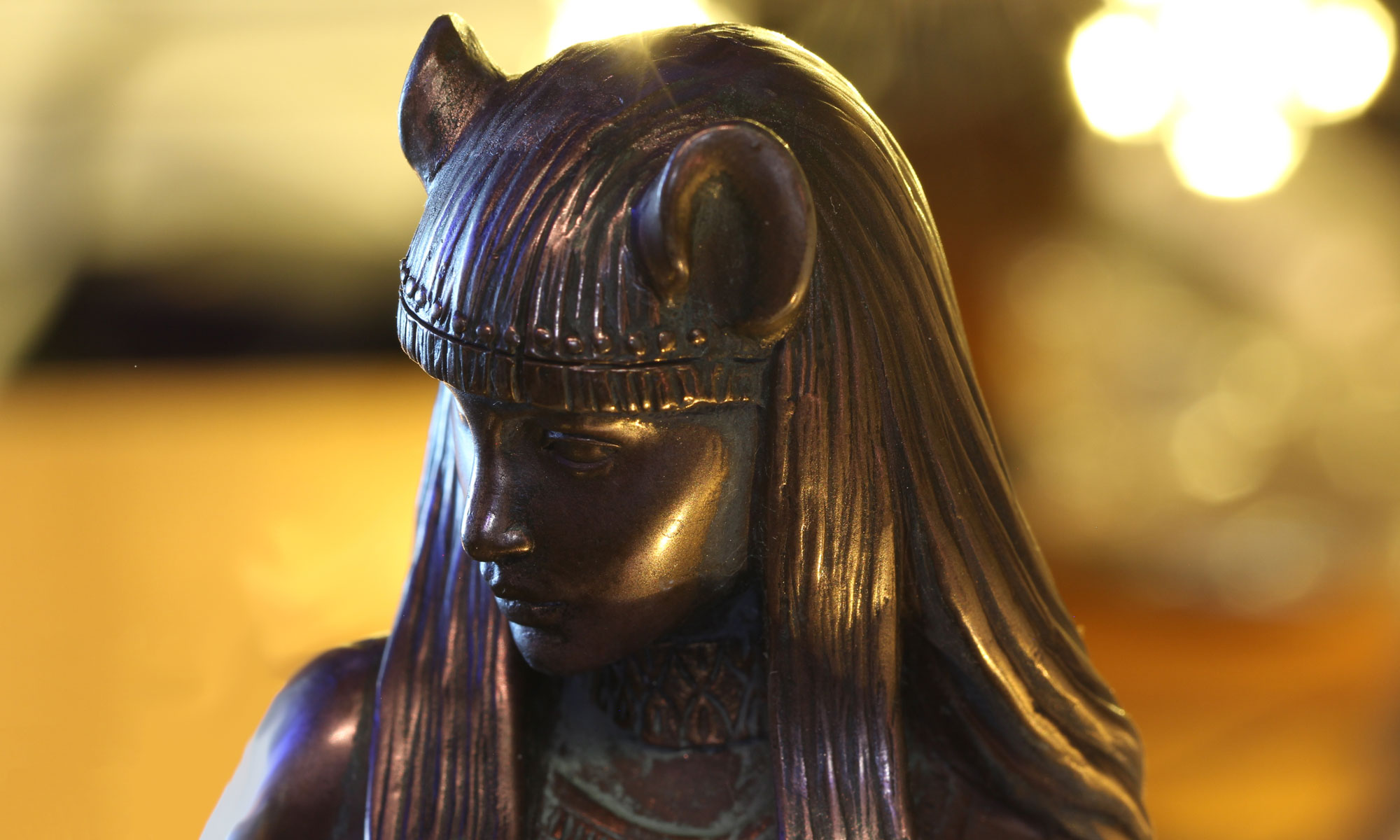
Announcing Scholar Salon 95: Register for Februrary 19

Let the Ancient Gods and Goddesses Organize Your Year

with Dr. Normandi Ellis

Thursday,  February 19, 2026 at 3:00 PM Eastern Time  

REGISTER HERE


Dr. Normandi Ellis at Alexandria

Across the ancient world, the Seven Sacred Planets were understood not as distant spheres of rock and gas, but as living intelligences—cosmic powers shaping destiny, consciousness, and your unfolding of life.  The five visible planets and the sun and moon ruled each day of the week. Used correctly, they provide inspiration for effectively engaging in our life tasks, performing the important activities of life at the right time. Not a HUGE astrological teaching, this talk will offer a simple way to look at and organize your daily/yearly calendar based on the intelligences of the planets.

Be sure to bring your planner and calendar to the talk!

Dr. Normandi Ellis

Dr. Normandi Ellis is an ordained clairvoyant Spiritualist minister and priestess of Isis. She is also an astrologer, numerologist, and teacher of metaphysics in a number of venues online and in person. Her books include Awakening Osiris: The Egyptian Book of the Dead, The Union of Isis an Thoth: Magic and Initiatory Practices of Ancient Egypt, Hieroglypic Words of Power, and The Ancient Tradition of Angels. She leads trips to Egypt and trains other priestesses of Isis through her lyceum, Per Ankh Het Seshet. Normandi has been a member of ASWM’s Advisory Board since the beginning of our work. Visit her website for  more information on her trips and teachings.

~~~~~~~~~~~~~~~~~~~~~~~~~~~~

Upcoming Scholar Salons (3pm Eastern Time):

Thursday March 5, with Dr. Carla Ionescu: She Who Endures: The Cult and Iconography of Artemis of Ephesus

Benefit of Membership - ASWM

This Salon recording will also be available to members when processed after the event. 


Final Home Page — Sage Art, Farrell Poem

From the Archives of MatriFocus
A Cross-Quarterly Web Magazine for Goddess Women Near & Far
Samhain 2009

TO OUR READERS

Much of MatriFocus (published Samhain 2001 to Lammas 2009) is archived here.

In four issues a year for eight years, MatriFocus published work on Goddess experience and history, feminism and community, seasonal awareness, earth-based spirituality, divination, ritual, and more. Over 100 writers and many more artists contributed their work.

At the time of final publication, MatriFocus had 2,000 subscribers, 25,000 unique monthly visitors, millions of hits per year, and a worldwide readership. Many MatriFocus articles are referenced in Wikipedia and numerous other websites and blogs.

MatriFocus began as a one-issue print zine for a small Dianic circle in Madison, WI. After that, the journal appeared on the web, edited by Sage, who was later joined by Feral as co-editor, Nano Boye Nagle as poetry editor, and first Dawn Work and later Giselle Vincett as scholarly editor. MatriFocuswas published in the spirit of the gift economy, without subscriber fees or advertising revenues, and offered an independent voice in the Goddess Movement.

Bringing writers, readers, artists, scholars, and practitioners together on the web has been volunteer work of the most exquisite kind for us. Though we’re moving on to other projects, we’re maintaining the MatriFocus archive online for readers new and old.

We thank everyone who participated in MatriFocus, contributors and readers alike. We look forward to experiencing the next generations’ work on these enduring subjects.

Blessed be.

Sage & Farrell


Bird-headed Snake Goddess.

© 2010 Sage (Starwalker) Collins
Pastel on paper
(after photo, Hallie Austen Iglehart’s The Heart of the Goddess)

Song for CedarWeb
Poem © 2010 Farrell Collins

We are the daughters of the fruited vine.
We are the daughters of the planted rows.
We are the daughters of cedar and pine.
We are the daughters of all that grows.
And we grow here among them,
And they grow here among us.
We are the daughters of wolf and whale.
We are the daughters of hawk and hare.
We are the daughters of otter and owl.
We are the daughters of deer and bear.
And we grow here among them,
And they grow here among us.
We are the daughters of the honey bee.
We are the daughters of the luna moth.
We are the daughters of the ladybug.
We are the daughters of the spider path.
And we grow here among them,
And they grow here among us,
And we grow, we grow, we grow…

About Stéphane Beaulieu

Illustrator: Stéphane Beaulieu
From the Archives of MatriFocus
A Cross-Quarterly Web Magazine for Goddess Women Near & Far
Discover More: “ASWM Presents MatriFocus

Smiley face
Stéphane Beaulieu is a student of comparative religions and an illustrator whose work can be seen in the long series of articles written by Johanna Stuckey for MatriFocus.

Contact The author retains the copyright to his work. Please do not use it without his permission. Contact mytras @ hotmail.com (remove the spaces).

Illustrations

Asherah, Supreme Goddess of the Ancient Levant

Author: Johanna Stuckey, PhD
Beltane 2004, Vol 3-3
From the Archives of MatriFocus
A Cross-Quarterly Web Magazine for Goddess Women Near & Far
Discover More: “ASWM Presents MatriFocus


Gold pendant.
Ugarit-Ras Shamra. 1550-1200/1150 BCE.
S. Beaulieu, after Negbi 1976, Plate 53, #1661.

As soon as El saw her,
he opened his mouth and laughed;
… he raised his voice and shouted:
“Why has Lady Asherah-of-the-Sea arrived?
why has the Mother of the Gods come?”
(Coogan 1978:100)

Although texts from the ancient Syrian city Ugarit do not explicitly name Asherah as consort of the supreme male deity, she was arguably his female counterpart, for she was Elat, “Goddess,” to his El, “God” (Hadley 2000:38). Indeed, Asherah and El function as “supreme couple,” and their offspring include “all the other deities in the first generation” (Olmo Lete 1999:47). Like El, Asherah was primarily a figure of authority, but only that authority which a patriarchal culture accords the feminine. Alone of Ugaritic goddesses, Asherah carried a spindle, which marked her as feminine and domestic (Coogan 1978:97; Hadley 2000:39).

Occurring near the top of deity and offering lists, Asherah was certainly the most important goddess at Ugarit (Binger 1997:89). Appropriately for the chief goddess of a sea-trading city, her full name, athirat yam, means “She treads on Sea,” (Coogan 1978:116; Hadley 2000:49-51). In the myths, while not having a central role, Asherah still plays a critical part. She has “sufficient power for El to be willing to take her advice concerning Baal’s successor” (Hadley 2000:39; Coogan 1978:111).

Since one of her epithets was “Creatrix, or Progenetrix, of the Gods” (Coogan 1978:97), and her sons numbered seventy, that is, a great many (Coogan 1978:104), Asherah was probably a “mother goddess.” Certainly, as “creatrix” and “wet nurse” of the gods, Asherah was “somehow related to birth and fertility” (Hadley 2000:43). However, given her authority and her role as power broker, it is unlikely that she was only a fertility goddess.

One of Asherah’s functions seems to have been to act as mediator between the other deities and the supreme El. Though the approach of the aggressive deities Anat and Baal terrifies her at first, Asherah calms down after they bestow sumptuous gifts on her, and, clearly higher in rank than they are, she undertakes to approach El on their behalf (Coogan 1978:98, 99-101 Hadley 2000:39).

Asherah could also be fierce in defence of her prerogatives. In one poem, Kirta, her punishment of a human vow-breaker is both swift and severe (Coogan 1978:67; Hadley 2000:41). It is this poem that mentions her supreme position at two other major cities of the ancient Levant, cities that she seems to have ruled well into the Roman period (Hadley 2000:42). She is “Asherah of Tyre” and “the goddess [elat] of Sidon” (Coogan 1978:63). The poem also uses the word Qudshu, which some translators render as “shrine” (Coogan 1978:63), but others as “Holy One,” probably an epithet of Asherah (Hadley 2000:47). The fact that El promises the king Kirta that Asherah will join Anat in suckling the royal heir suggests that Asherah too was a “divine guarantor of the throne” (Pettey 1990:16).

The chief female deity at Ugarit was also revered in other parts of the Levant, and a good deal of evidence suggests that Asherah may have had an especially close relationship with trees. Such a relationship would not be surprising since, generally in the ancient Eastern Mediterranean, goddesses and what scholars call “sacred trees” seem to go together. Excavated in the Late Bronze Age Canaanite city of Lachish (Tubb 1998:79-80), the Lachish Ewer is usually understood as Canaanite and dated to “the late thirteenth century B.C.E.” (Hestrin 1987:212). Its decoration “consists of a row of animals and trees,” above which there is an inscription: “Mattan. An offering to my Lady `Elat” (Hestrin 1987:211,214). A person named Mattan presented the ewer and probably its contents to the temple of the goddess Elat ((Hadley 2000:159).

 the shard of the Lachish Ewer with Elat above the tree
Decorated potsherd.
Lachish, Israel. 1550-1200/1150 BCE.

S. Beaulieu, after Keel and Uelinger 1998:73, #81

What is really intriguing is that the word for goddess, Elat, is positioned right over one of the stylized trees (Hadley 2000:156; 157, #8). The artist finished the drawings and then did the inscription (Hadley 2000:160), so that the placing of the word was “not by chance” (Hestrin 1987:220). Thus, the word Elat was probably placed so as to designate the tree as the goddess, to indicate that it “represented her presence” (Smith 1990:82).

However, to which of the Levantine goddesses did Elat refer? In the Hebrew Bible, elah, the grammatically feminine form of el, occurs seventeen times, but is always translated as “oak or “terebinth,” that is, a living tree. Further, “all occurrences of the word can be understood as tree” without damaging the text; however, in some places, the translation equally could be “goddess” (Binger 1997:135). In the Ugaritic texts, although elat can mean “goddess in a rather general way,” it can also be one of Asherah’s titles, “nearly a name” (Pettey 1990:13).

As a result, quite a number of scholars think that the “Elat” of the Lachish Ewer names the Canaanite goddess Asherah (Hadley 2000:159-160; Keel and Uehlinger 1998:72; Pettey 1990:181; Smith 1990:82; Hestrin 1987:220). However, this identification does not prove, conclusively, that the Levantine sacred tree always represented Asherah, though it is clear that a sacred tree could represent any or all of the goddesses.


Decorated potsherd.
Lachish, Israel. 1550-1200/1150 BCE.
S. Beaulieu, after Keel and Uelinger 1998:73, #80.

Another artefact from the Lachish excavations adds to the argument. It is a goblet decorated with “two ibexes facing each other, repeated four times” (Hestrin 1987: 215). They are flanking not by a tree, but by “an inverted triangle strewn with dots” (Keel 1998:34; Part I, #50; Hestrin1987:215, #2; 216, #3). Most scholars interpret the inverted image as a pubic triangle (Keel and Uehlinger 1998:72; Hestrin 1991:55; Hestrin 1987:215). This well-known image, then, they see as replacing of the sacred tree with the vulva symbol making it highly likely “… that the tree indeed symbolizes the fertility goddess …” (Hestrin 1987:215). In response to scholarly doubts, Othmar Keel discusses “recently published evidence” from three different sites in Israel that “may confirm” that the triangles on the Lachish goblet do represent pubic triangles (Keel 1998:34-35; Part I, #51, 52).


Ivory box cover.
Ugarit-Minet el-Beida.
1550-1200/1150 BCE
S. Beaulieu, after Patai 1990, Plate 19.

Thus, it seems that, in the Bronze Age Levant, tree was all but synonymous with goddess. Not only do pendants depict goddesses with trees growing up from their vulvic triangles (see image, top of the page) and seals and other artifacts show trees, complete with browsing animals, next to goddesses, but one of the most beautiful objects from Ugarit presents a goddess as a tree(1). On a fragment of a carved ivory lid of a small box, a goddess takes the position normally held by the sacred tree and feeds goat-like animals that lean forward and upward to take the vegetation out of her hands (Keel 1998: Part I, #43; Patai 1990: Plate19). Despite this exquisite Late Bronze testimony to the identity of goddess and tree, Keel demonstrates that, by that period, the figure of the goddess “is to a large extent replaced by the tree flanked by caprids” (Keel 1998:35). Gradually, throughout the Iron Age, the image of sacred tree with goat-like animals became rare in Israel and Judah (Keel and Uehlinger 1998:399-400), though it continued as an important symbol in surrounding ancient Eastern Mediterranean cultures. The tree symbol, however, may have survived even in Judah in the form of “the seven-branched lampstand of the priestly tradition” (Keel 1998:56).

From its mythic and cultic texts, we saw that Asherah was chief goddess of Ugarit, as well as of the cities of Tyre and Sidon. Undoubtedly, Asherah continued to be an important goddess in the Levant during the first millennium BCE, especially in certain localities. Further, it is possible that she was, for a time, consort of Israel’s god Yahweh [an argument that I will discuss in my next column]. However, it was Asherah’s fate, like that of both Anat and Astarte, slowly, to begin to disappear as a separate entity.

The identity of Carthaginian Tanit has been a focus of scholarly dispute, with cases being made for all three Canaanite great goddesses (Pettey 1990:32). However, there appears now to be general agreement that Asherah probably survived in Tanit, the chief deity of the highly successful Phoenician colony of Carthage in North Africa (Pettey 1990:32). With the Carthaginians, Tanit/Asherah worship spread far from her original Levantine homeland across the Mediterranean into Western Europe. In addition, as we have seen, during the Greco-Roman period, a great goddess Atargatis was worshipped in the Levant, and her name indicates that she was probably a fusion of all three Levantine great goddesses (Pettey 1990:32-33). Spreading from Syria across the Mediterranean, Atargatis’s worship continued well into the third century of our era (Godwin 1981:150-152, 158 #124). Thus, Asherah and her sister goddesses went on living as part of the powerful and much-adored “Syrian Goddess.”

Notes

    1. The object looks Late Mycenaean in style, but the “symmetric arrangement is purely Mesopotamian and Syrian …” (R.D. Barnett cited in Keel 1998:31).

Bibliography

    • Binger, Tilde 1997. Asherah: Goddesses in Ugarit, Israel and the Old Testament. Sheffield, UK: Sheffield Academic. Journal for the Study of the Old Testament, Supplement Series 232.
    • Coogan, Michael D., tr. 1978. Stories from Ancient Canaan. Louisville, KY
    • Godwin, Joscelyn 1981. Mystery Religions in the Ancient World. London: Thames and Hudson.
    • Hadley, Judith M. 2000. The Cult of Asherah in Ancient Israel and Judah: Evidence for a Hebrew Goddess. Cambridge: Cambridge University.
    • Hestrin, Ruth 1987. “The Lachish Ewer and the `Asherah,” Israel Exploration Journal 37:212-223.
    • Keel, Othmar 1998. Goddesses and Trees, New Moon and Yahweh: Ancient Near Eastern Art and the Hebrew Bible. Sheffield, UK: Sheffield Academic.
    • Keel, Othmar and Christoph Uehlinger 1998. Gods, Goddesses, and Images of God in Ancient Israel. Minneapolis, MN: Fortress.
    • Negbi, Ora 1976. Canaanite Gods in Metal: An Archaeological Study of Ancient Syro-Palestinian Figures. Tel Aviv: Tel Aviv University.
    • Olmo Lete, Gregorio del 1999. Canaanite Religion According to the Liturgical Texts of Ugarit. Bethesda, MD: CDL.
    • Patai, Raphael 1990 (1978). The Hebrew Goddess: Third Enlarged Edition. Detroit, MI: Wayne State University.
    • Pettey, Richard J. 1990. Asherah: Goddess of Israel. New York: Lang.
    • Smith, Mark S. 1990. The Early History of God: Yahweh and the Other Deities in Ancient Israel. San Francisco: Harper and Row.
    • Tubb, Jonathan N. 1998. Canaanites. Norman, OK: University of Oklahoma.

Graphics Credits

Astarte Goddess of Fertility, Beauty, War, and Love

Author: Johanna Stuckey, PhD
Imbolc 2004, Vol 3-2
From the Archives of MatriFocus
A Cross-Quarterly Web Magazine for Goddess Women Near & Far
Discover More: “ASWM Presents MatriFocus

line drawing of a gold pendant from 1500 BCE with Goddess Astarte and animals
Gold pendant, possibly Astarte. Ugarit. 1500-1200/1150 BCE.
Drawing © Stéphane Beaulieu, after Toorn 1998:86, #31

Known in the ancient Levant as Ashtart and in the Hebrew Bible as Ashtereth, the beautiful Astarte may owe many of her characteristics to Mesopotamian Ishtar, as the similarity in their names proclaims. Like Ishtar, Astarte seems to have had strong connections with both war and love/sexuality. In historical times, she received offerings in ancient Ugarit in Syria; her name appears forty-six times in texts from that city. One of her main centers was Byblos, where she was identified with Egyptian goddesses Hathor and Isis. In the second millennium BCE, Astarte was, like Anat, a war goddess of the Egyptians (Patai 1990:56). Large numbers of ancient Israelites revered her, and versions of her name occur at least nine times in the Hebrew Bible. She was also an important deity of the Phoenician towns of Tyre and Sidon, whence she and her veneration spread with Phoenician merchants throughout the Mediterranean (Patai 1990:55-66).

The Ugaritic poems present Astarte as a model of beauty and usually associate her closely with Baal, the storm god, for she consistently supports his cause (Coogan 1978:61, 65, 74, 89, 116). On at least five occasions the mythic material pairs her with Anat, perhaps an indication that the two goddesses were already beginning to meld into one another. Yet, since Astarte’s name occurs quite often in offering and deity lists, it is clear that she had an important, if not central place in ritual and sacrifice (Olmo Lete 1999:71). An enormous number of female images originated from the excavations at Ugarit, and scholars have labeled many of them as Astarte. However, to date, no one has been able to demonstrate that they actually represent Astarte.

The Hebrew form of Astarte’s name ashtereth, which occurs only three times in the Hebrew Bible, resulted from the deliberate replacement of the vowels in the last two syllables of the goddess’s name with the vowels from the Hebrew noun bosheth, “shame” (Day 2000:128; Buttrick 1990:I,255). According to Patai, the “original meaning of the name Astarte was ‘womb’ or ‘that which issues from the womb,'” an appropriate title for a fertility goddess (Patai 1990:57). In statements about Syro-Canaanite religion, the Biblical texts often couple the ashteroth, “the Astartes,” with the baalim, “the Baals,” an indication that the writers knew that many local versions of these deities existed. However, this repeated connection of Astarte and Baal has led some scholars to conclude that the Hebrew Bible understood Astarte to be Baal’s consort (Day 2000:131; Patai 1990:57). If she were his consort, she too should have associations with fertility.

Astarte’s name also occurs in the Hebrew Bible as part of a place name, Ashteroth Karnaim, karnaim meaning “of the two horns” (Genesis 14:5). Ashteroth Karnaim, perhaps the “full old name of the city,” (Patai 1990:57), was probably a temple center where Astarte was worshipped as a two-horned deity. In support of this suggestion, Patai points to a mold from a shrine in Israel depicting a goddess with two horns. Dated between the eighteenth and the sixteenth centuries BCE, the mold shows a naked goddess in a high, conical hat. She has two horns, one on each side of her head (Patai 1990:57, Plate 9).

Two passages in the Book of Jeremiah (7.17-18 and 44.15-19) refer to ancient Israelite worship of a “Queen of Heaven.” These passages provide a very rare glimpse into ritual practices of Judahite popular religion. Around the turn of the seventh century BCE, Jeremiah preaches to Israelite exiles in Egypt. To his horror whole families, with women in the lead, were making offerings to a goddess. They poured libations, built fires, and baked “cakes [kawwanim] for the Queen of Heaven” (Jer.7:18). The scholarly literature presents a number of theories about who the “Queen of Heaven” was (Toorn 1998:83-88; Patai 1990:64). However, since “Queen of Heaven” was one of the many titles of the Mesopotamian goddess Inanna-Ishtar, for whom worshippers also made cakes [kamanu], it is possible that the goddess in the Jeremiah passages was Astarte (Toorn and Horst 1999:678-679; Patai 1990:64)

line drawing of a clay cult stand from the 9th century GCE with Goddess Astarte and animals
Clay cult stand.
Taanach, Israel. Late ninth century BCE.
Drawing © Stéphane Beaulieu, after Gadon 1989:174, #97.

An elaborate terra-cotta cult stand from ancient Taanach in northern Israel may have been used in the worship of Astarte (Gadon 1989:174, Figure 97). Just over twenty-one inches in height, it dates to the tenth century BCE, during the period when the Israelites were establishing themselves in the land (Hadley 2000:169). In the center of the bottom level, as if underpinning everything, stands a naked goddess controlling two flanking lions. The second register contains an empty, door-like space flanked by winged sphinxes wearing goddess locks. On the next level, two ibexes nibble at a sacred tree, a scene which is flanked by lions. The top register is occupied by a quadruped, either a bull calf or a young horse, which strides between two door posts. Above it is a rayed or winged sun disc.

Explanations of the stand vary from understanding it as totally Canaanite to its being an Israelite cult object dedicated to the Israelite deity and a consort (Hadley 2000:169-176). There is, however, general agreement that the piece models a temple to the deities or deity depicted on the façade, with the tiers displaying temple scenes (Hadley 2000:171-172).

Interpreted strictly as a Canaanite cult object, the Taanach stand depicts either important Canaanite deities, female and male; or goddesses alone; or even a single goddess. In these views, the bottom level shows the naked goddess and the third level from the bottom her symbol, the sacred tree. The empty space on level two is a doorway into the shrine, and the door posts on level four frame either a temple entrance or the “holy of holies” (Hadley 2000:172). Between these posts, either the Canaanite god El or the storm god Baal Hadad manifests himself in the form of a bull calf (Hadley 2000:172-173).

Since a goddess is central to the symbolism of the Taanach stand, I would argue that a goddess is there also in the door on level two and the animal on level four. The symbolism of the cult stand suggests that this Levantine goddess is very similar to the Mesopotamian great goddess Inanna-Ishtar (Stuckey 2001:92-94). The female figure on the bottom register underpins everything; she is the foundation of all and so queen of heaven, earth, and underworld. She is both life and death, the latter present in the menacing lions which she controls. Above her, there looms both the door to her shrine and the mystic entrance to her realm both on earth and in the underworld. More important, it is the symbol of her essential nature: like Sumerian Inanna, she embodies change (Stuckey 2001:95). To enter into her realm is to undergo transformation, whether by dying on the battlefield, being born, falling in love, engaging in sexual activity, or leaving the ordinary and, through ritual, entering sacred time and space.

The tree on level three is yet another statement of the goddess’s presence, and, like her, it has its branches in the heavens, its trunk on the earth, and its roots reaching toward the world beneath the earth (Stuckey 2001:101). The animal on the fourth level, which I think may be a bull calf, probably represents her consort, the storm god, whose function it is to bring rain to fertilize the earth so that the life cycle can go on. Given what we know about Canaanite religion in the first millennium BCE, I would assign the Taanach stand tentatively to Astarte, who seems, at that time, to have been consort of the storm god Baal (Patai 1990:56-57).

Devotion to Astarte was prolonged by the Phoenicians, descendants of the Canaanites, who occupied a small territory on the coast of Syria and Lebanon in the first millennium BCE. From cities such as Byblos, Tyre, and Sidon, they set forth by sea on long trading expeditions, and, venturing far into the western Mediterranean, they even reached Cornwall in England (Tubbs 1998:140-141). Wherever they went, they established trading posts and founded colonies, the best known of which was in North Africa: Carthage, the rival of Rome in the third and second centuries BCE (Tubbs 1998:142-145). Of course they took their deities with them. Hence, Astarte became much more important in the first millennium BCE than she had been in the second millennium BCE (Patai 1990:56-57). In Cyprus, where the Phoenicians arrived in the ninth century BCE, they built temples to Astarte, and it was on Cyprus that she was first identified with Greek Aphrodite (Friedrich 1978).

The Greco-Roman period saw another great Levantine goddess called Atargatis being worshipped in the Levant and elsewhere. Her name seems to have come from a combining of the names Astarte and Anat. On the other hand, it may have resulted from a fusion of the names of all three Levantine great goddesses (Toorn and Horst 1999: 111). To the second century of our era is dated a Greek account of the “Syrian” Goddess”; the work is traditionally attributed to the satirical writer Lucian. Though the writer gives Greek names for the deities he describes, the goddess of the title is clearly Atargatis (Lucian 1976:4). The worship of Atargatis spread from Syria across the Mediterranean and lasted well into the third century of our era (Godwin 1981:150-152, 158 #124). Thus, long after she lost her independent identity, Astarte lived on in a composite “Syrian Goddess.”

References & Suggested Readings

  1. Buttrick, George A., ed. 1991. The Interpreter’s Dictionary of the Bible: An Illustrated Encyclopedia. Nashville, TN: Abingdon
    Coogan, Michael D., tr. 1978. Stories from Ancient Canaan. Louisville, KY: Westminster
  2. Day, John 2000. Yahweh and the Gods and Goddesses of Canaan. Sheffield, UK: Sheffield Academic. Journal for the Study of the Old Testament, Supplement Series 265
  3. Friedrich, Paul 1978. The Meaning of Aphrodite. Chicago: University of Chicago
  4. Gadon, Elinor 1989. The Once and Future Goddess: A Symbol for Our Time. San Francisco: Harper and Row
  5. Godwin, Joscelyn 1981. Mystery Religions in the Ancient World. London: Thames and Hudson
  6. Hadley, Judith M. 2000. The Cult of Asherah in Ancient Israel and Judah: Evidence for a Hebrew Goddess. Cambridge: Cambridge University
  7. Houtman, C. 1999. “Queen of Heaven…,” 678-680 in Dictionary of Deities and Demons in the Bible DDD. Second Extensively Revised Edition, ed. K. van der Toorn, B. Becking, and P. W. van der Horst. Leiden: Brill
  8. Lucian 1976. The Syrian Goddess (De Dea Syria) Attributed to Lucian. Ed. H.W. Attridge and R.A. Oden. Missoula, MT: Society of Biblical Literature/Scholars
  9. Olmo Lete, Gregorio del 1999. Canaanite Religion According to the Liturgical Texts of Ugarit. Bethesda, MD: CDL
  10. Patai, Raphael 1990 (1978). The Hebrew Goddess: Third Enlarged Edition. Detroit, MI: Wayne State University
  11. Stuckey, Johanna H. 2002. “The Great Goddesses of the Levant,” Bulletin of the Canadian Society for Mesopotamian Studies 37:27-48
  12. Stuckey, Johanna H. 2001. “`Inanna and the Huluppu Tree’: An Ancient Mesopotamian Narrative of Goddess Demotion,” 91-105, in Feminist Poetics of the Sacred: Creative Suspicions, ed. F. Devlin-Glass and L. McCredden. Oxford: Oxford University</li
  13. Toorn, Karel van der 1998. “Goddesses in Early Israelite Religion,” 83-97, in Ancient Goddesses: The Myths and the Evidence, ed. L. Goodison and C. Morris. Madison, WI: University of Wisconsin
  14. Tubb, Jonathan N. 1998. Canaanites. Norman, OK: University of Oklahoma
  15. Wyatt, Nicolas 1999. “Astarte…,” 109-114, in Dictionary of Deities and Demons in the Bible, ed. K. van der Toorn, B. Becking, and P.W. van der Horst. Leiden: Brill

Graphic Credits