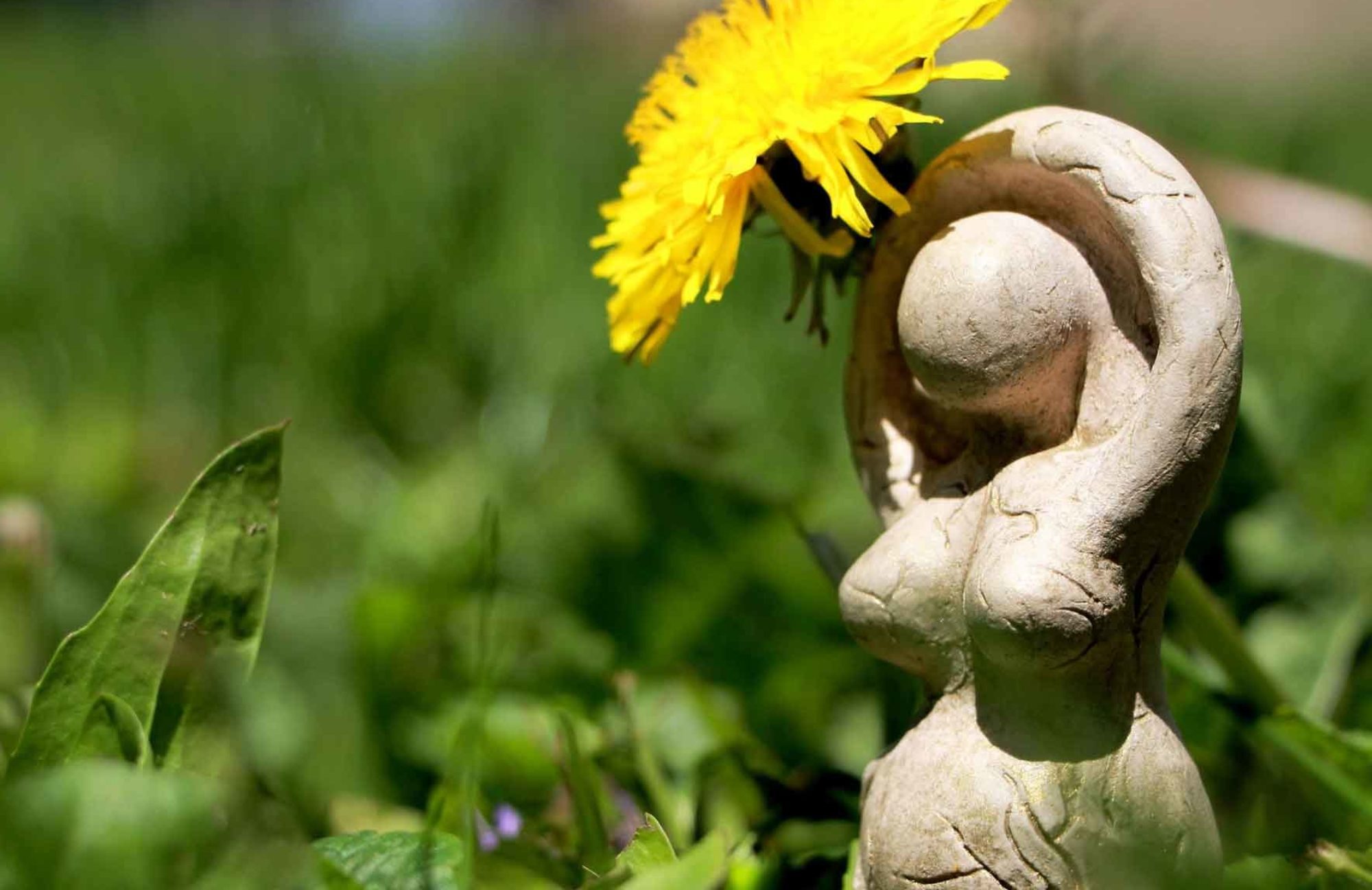
Dr. Cristina Eisenberg will present the Saturday keynote for our 2016 conference. This cutting-edge presentation will weave a web of connections among animals, humans, myths and foremothers.
Dark Ecology is a post-modern philosophy based on the premise that there is no division between the human and the non-human. For millennia, animals and humans shared ecosystems, moving together in a trophic, spiral dance, celebrating life across the ebb and flow of the seasons through birth and death, great migrations, the sanctity of the hunt. Modern humans imposed a mechanistic, anthropocentric, masculine view of the world, one based on human dominion over nature. Today we know that such beliefs are completely untenable and have led to the ecological wreckage we see worldwide. As we strive to mend the tangled web of life and repair the damage we’ve wrought to whole ecosystems and all the beings that inhabit them, the animals, particularly animal mothers, are functioning as guides as they always have. These animals are teaching us profound lessons in dark ecology: what it means to be human and nonhuman and how there really is no dividing line, how we are but part of the same continuum. Their lessons will enable us to live more rightly on the earth and restore the planet and our human spirits. Cristina Eisenberg will share some of the lessons she’s received from animal mothers she’s known and others that have shaped her work as a scientist. She will discuss the bright chimeric hope these animal teachers have to offer to humanity.
THE AMAZONS: Lives and Legends of Warrior Women across the Ancient World (Princeton, 2014)
It is with great pleasure that ASWM confers the 2016 Sarasvati Book Award for Nonfiction to THE AMAZONS for its power in reframing knowledge about our female ancestors and reawakening scholarly as well as metaphysical and physical pathways that link history and myth.
Think of everything you know about the ancient mythological warrior women collectively known as the Amazons–and prepare to have most of it overturned. In a breathtaking achievement of research and methodical exploration of archaeological, literary, and artistic sources, Adrienne Mayor sifts through centuries of evidence to get at the reality of who the Amazons were, where and when they lived, what they did, and how they did it.
The award letter states,
The authoritative command of the research reveals the Amazons as they have never been seen before, not merely figments of the Greek imagination, but actual flesh and blood warrior women of nomadic cultures, inspiring exciting tales from ancient Egypt, Persia, India, Central Asia and China. First to examine the evidence systematically and in detail, the book reveals the truth behind storytelling as it persuasively elucidates the history, art, and imagination of ancient peoples, drawing on an impressively diverse set of data sources from classical myth, nomadic traditions and folklore, and scientific archaeology to visual representations from Greek pottery to body tattoo.
Dr. Adrienne Mayor, photo by Josiah Ober
Adrienne Mayor, a research scholar in Classics and History of Science, Stanford University, is the author of The First Fossil Hunters: (2000); Fossil Legends of the First Americans (2005); Greek Fire, Poison Arrows & Scorpion Bombs: Biological and Chemical Warfare in the Ancient World (2003); The Poison King: Rome’s Deadliest Enemy (2010, National Book Award nonfiction finalist); The Amazons: Lives and Legends of Warrior Women across the Ancient World (2014); and many scholarly and popular articles. Her work is featured on NPR, BBC, History Channel, New York Times, USA Today, Smithsonian, and National Geographic and she is a regular contributor at WondersandMarvels.com.
The Sarasvati Award, named for the Hindu goddess of learning and the creative arts, honors creative work in the fields of goddess and mythology studies. The award is presented biennially at ASWM conferences. The award will be accepted this year by Dr. Miriam Robbins Dexter on behalf of Dr. Mayor.
Past winners of the Sarasvati Award for Nonfiction include Sacred Display: Divine and Magical Female Figures of Eurasia by Miriam Robbins Dexter and Victor H. Mair (Cambria, 2010). and The Dancing Goddesses: Folklore, Archaeology and the Origins of European Dance, by Elizabeth Wayland Barber (Norton, 2013).
9-11 September 2016 at Newcastle University and Durham University
Keynotes: Sandra M. Gilbert (UC Davis), Wendy Furman-Adams (Whittier), John Bothwell (Durham)
From Genesis to mitochondrial Eve, the idea of a single common foremother has occupied a crucial space in the Western cultural imaginary. Eve, whether as bringer of sin, as life-giver, as burden, curse or saviour, functions as a commentary on maternity, sexuality, creativity and power. This cross-period and interdisciplinary conference will be an opportunity to explore the impact of her varied representations through the centuries and across different genres and media. How has this archetypal figure been revised and revisited by conservative and radical thought? What personal, polemical and/or creative uses have been made of the figure of Eve? What persists and what changes in her depictions across time and geographical space? How have women and men negotiated their shared and different relationships to Eve? How has Eve been appropriated, neglected or rejected as a foremother? How does she speak to fantasies of masculine or feminine self-sufficiency? What cultural, political, literary and/or theological spaces does she occupy now? Topics might include, but need not be limited to:
Origins of/Sources for Eve Other Eves The absence of Eve Representations and Transformations of Eve Eve as Over-reacher
We welcome papers from all disciplines in arts, humanities and sciences and covering any historical period. We also welcome panel proposals including PGR panel proposals. Titles and abstracts of no more than 250 words per speaker should be sent to Ruth Connolly (ruth.connolly@ncl.ac.uk) and Mandy Green (mandy.green@durham.ac.uk) by 12 March 2016. Panel proposals should also include a title for the panel’s programme. Speakers will be notified by March 21st.
We gratefully acknowledge support from MEMS at Newcastle (http://research.ncl.ac.uk/mems/), Newcastle University’s Academic Conference Fund and also from IMEMS at Durham University (https://www.dur.ac.uk/imems/research/). (A limited number of PGR bursaries may be available. Please indicate when sending your abstract whether you would like to be considered for a bursary.)
Important links are listed below, or you may scroll through this blog to see all posts about the conference. Here you will find articles about the program, presenters, and special opportunities.
Our pre-conference registration deadline has now passed. We will accept walk-in registrations on Friday, April 1, starting at 7:30 AM.
Accommodations are at Boston Marriott Hotel Burlington:
Register for Matriarchal Studies Day here (March 31, the day before our coference, at the same location, but with separate registration) or contact cichon @ oakton.edu
Stay for this Sunday workshop with Vicki Noble and Julie Felix: TRANSFORMATIONAL HEALING RITUAL in Boston (Medford) Sunday, April 3rd, from 2:30 – 5:30 pm Bring drums and rattles. Please RSVP to Nouri Newman nourinewman@comcast.net.
“Wilderness is one of our best defenses against climate change.”
Cristina Eisenberg is Chief Scientist for Earthwatch Institute, a Smithsonian Research Associate, and science consultant for many prestigious organizations in the US and Canada. Her research has investigated trophic cascades and the effects of predators on landscape health and biodiversity. She has emerged as a leading voice for wilderness and large predator conservation in North America.
Cristina is the author of The Wolf’s Tooth and The Carnivore Way: Coexisting with and Conserving America’s Predators. Matt Miller, reviewing The Carnivore Way for Cool Green Science, (June 12, 2014) says
“Eisenberg is the perfect scientist to write this book. She lives in a Montana cabin where she encounters the predators of which she writes: wolves, mountain lions, grizzly bears, lynx. . . .Her research and review of the literature leave her convinced that large predators are essential for landscape health, and vital for our own values of wildness and wonder.”
“In order to create change, you have to engage people, and you have to not just engage their minds. You have to engage their hearts, and that means telling our stories. . . . In terms of carnivore conservation, we need to build community. We need to have that solid science, and we need to find a way to share our story.”
Cristina Eisenberg’s special conference presentation is entitled “The Role of the Traditional Ecological Knowledge in an Era of Global Change.” She will discuss the changes taking place from ecological, ethical, and feminine mythological perspectives, and how the values embodied by Traditional Ecological Knowledge across world cultures contain the elements essential for human survival and for the wellbeing of all life on Earth.
“Traditional Ecological Knowledge that taps into the divine feminine can teach us much in terms of how to live more rightly on this Earth, how to heal the damage we have done, and how to mitigate, adapt to, and slow the processes that threaten every living being today. ”
Cristina Biaggi
Sculptor/scholar Cristina Biaggi
The Great Goddess, in whatever manifestation she was depicted, was the supreme deity in the Paleolithic and Neolithic period throughout the world. She has re-emerged in the 20th and 21st century as an apt symbol of woman’s growing consciousness and importance. The need to make the Goddess accessible through art as an embodiment of “feminine sensibility” is becoming extremely important in this world of growing militarism.
Cristina Biaggi, artist, activist and scholar, has achieved international recognition as a sculptor of bronze and wood pieces. Using the theme of interconnection, she has also created large outdoor installations, and has explored collage in the two and three dimensional form. Her work has been exhibited throughout the United States, Europe and Australia. She is a respected authority on the Great Goddess, Neolithic and Paleolithic prehistory, and the origin and impact of patriarchy on contemporary life.
“I create my sculptures inspired by these ideas. Sculpture in the Western world has lost the mystical magical presence that it had during the Neolithic period when a temple or a sculpture was considered to be the body of the deity. In creating my sculpture, I wish to bring back some of this magic and mystery. I want to create a space that inspires mystery; that evokes the dark caves of the Goddess – places of rebirth and revitalized consciousness.”
“Cristina Biaggi’s work –seminal, gorgeous, provocative. No one like her!” Olympia Dukakis, Film and Stage Actor
Cristina’s presentation “Matriarchy as Inspiration for Art” is included in the Panel: Matriarchal Studies: Past Debates and Present Practices
You must be logged in to post a comment.